Welcome to 2018! I usually end the year with a list of a few titles so, although I lost much of the start of the year's reading time with a move (more on that below), I'll begin with a selection of the books I managed to pore over mostly through a combination of my sheer stubborn will and desperation when viewing my to-be-read mountain.
I'm never certain how I feel about Patrick Gale's work simply from a personal preference. His works read, to me, as though I've dipped into someone's life and been forced to step out again. This is not a fault by any means -- many such works have received critical acclaim, and the plotting of this has to be admired. In Notes from an Exhibition, I loved the non-linear sequence of the storytelling but found myself irritated with many of the characters. Again, this is not a negative -- fully-fledged characters can be as frustrating as people may be in reality. The story is ultimately one that's a painful glance into mental illness. Another book that made it more apparent to me why I'm never sure whether I love or simply appreciate Gale's work was A Perfectly Good Man. It's style vs content. There's too much telling rather than showing but I love the way the author can jump back and forth with the timeline without losing the reader, and I enjoyed the overall plot of this one.
I don't usually speak of a book and a film in the same paragraph but for The Girl with all the Gifts, by M.R.Carey I advise reading the book, forget the film. If you've seen the film, read the book. This is your zombie survival story with a backdrop of intelligent science and equally intelligent twists. The film lacks the depth of character development and interaction of the book, coming across as a made-for-TV movie, paring the story down to stripped bones. The writing, though aimed more at a young adult audience, is worth consideration for any zombie fan.
His Bloody Project, by Graeme Macrae Burnet, is the fictional 'factual' telling of the 'bloody' deals of one Roderick Macrae. In a sense, there's little plot to this book. There's a crime, the perpetrator's account, a court case, and a verdict. What makes this book stand out is the readability and even enjoyment of the story's working. The research and tone make one feel as though the reader has taken a step back in time, paying witness to the events on which a young man's life 'hangs' (forgive the pun). The book is persuasive and although leaves some uncertain it's noteworthy to mention that the author managed to make this reader at least feel more sorry for the criminal than the victims.
The Box, by Jack Ketchum, is a short story that appears to engender a love or loathe response. I would have made it more visceral but I still liked it, being the type of thing I would write. Either you're someone for whom the story cannot be complete without the revelation of what is in the box or you're someone whose imagination can take flights of fancy.
If you're looking for an extraordinary suspenseful passionate adventure, consider Project Prometheus 1: In Her Name, by Esther Mitchell. It's a shame some readers of suspense may shy from the romantic elements, and some readers of romance may hesitate to delve into a world so richly layered as this, but what action-packed blockbuster doesn't contain components of both? The romance is far from saccharine and the action far from puerile. The reading experience was much like watching a feature film play out, and I equate the 'experience' of reading this in that format -- like watching a television series. Though not the type of material I would routinely read, the writer's command of world building, story-layering, knowledge, and use of myth and fact, means I'll be reading the rest of this series, though the first can be read as a standalone book.
The Man Who Disappeared, by Clare Morrall was a book I found difficult to rate. My feelings fluctuated so much. Oddly it's written in a tense seldom used but I had no problem with that or the writing itself. I did have some issues with the characters and their choices, but more than that, at times I had issues with what the characters took offence at and what they did not. The problem is we all have our own experiences and beliefs, and only through research can a writer put over an opinion that may not be theirs. In other words, I was judging the character's reactions by how I would react, and how I would feel, so I don't wish to mark the book down. I'm not a reader who believes a writer is necessarily wrong just because I think some points of the story should have gone a different way. I found this a decent read but not a keeper.
Off Season, by Jack Ketchum, I rate middle of the road because it's an excellent read of its type but I generally prefer my horror books a little deeper and not completely action-based. I found this more like watching a gory horror film than being immersed in a book. If it's the type of action-based brutal horror story someone likes it'll be excellent for them so it's one for individual judgement. Most interesting was the author's notes at the end of how this book was first received and severely cut by the publisher even to the point where the author didn't get to keep the end he wanted. On that note, I applaud the republication of the author's original intention...and much prefer the author's conclusion. Once upon a time, the graphic nature of the book would have been seen as too extreme but to some will seem mild now. I can't say it's a book I enjoyed because of the content. Neither did I dislike it, nor was it instantly forgettable, but it's not a book I'll be keeping. This is the first time I've read Jack Ketchum though I'm aware his work has a wonderful reputation. I can't say from this one book whether he's an author for me.
In contrast, Meat, by Joseph D'Lacey, is a questioning form of horror. I won't linger on the small fact that I felt the writing could have done with a slight tidy, or that the formatting on the copy I read was less than perfect. That and the plot reservations I was ultimately left with means I couldn't give the book a perfect rating. However, I can't see how the author could have written a different outcome. This is, without doubt, a dark dystopia, one that's as gruesome as it is possible to imagine. No real surprises but richly developed into a solid conceptual future designed by accident or intent to make the reader question their ethics. I'd be happy to read more by this author.
The Wolves of London, Obsidian Heart 1, by Mark Morris, isn’t what I would strictly call a horror novel. It’s one of those instances where genres blend to mesmerising effect including touches of urban fantasy and even steampunk and, yes, horror, because, some of the strange world the protagonist, Alex Locke, stumbles into is as horrific as it is fantastical and magical. This book won’t please every reader, but it will entertain many who appreciate the use of a wild imagination, being slowly drawn into a stranger than average universe, who are prepared to suspend disbelief and give credence to any and all possibilities. I personally like the unhurried progress, the twists and turns, and quirks of the story. The peculiar surprises. Granted, towards the end, the book starts to feel a little disconnected and jerky but that’s owing to plot points being established for the arc of the series. This book will leave the reader with more questions at the end than at the start. Who are the Wolves of London? What is the Obsidian Heart and what powers does it hold? Why has Alex been chosen, and why does it seem as if he’s part of some design constructed by unknown antagonists, possibly his growing list of enemies? Whether it’s a perfect set-up I won’t be able to say until I read the whole trilogy. Neither can I say whether I will love the story as a whole once I finish, but I do know, having read this, I have to discover how the story concludes.
I finished the year in November by reading 11.22.63, Stephen King. Firstly, for a UK audience, the title likely made a few people blink if they are unaware that the US writes dates differently to the UK. Here, we write the date chronologically: day, month, year. This being a pivotal date in US history, I'm not criticising this, but I could understand if, to some readers, it didn't automatically click that the numbered title is a date. Did I enjoy the book? Yes. Did it have as much to do with Kennedy's death as I thought it would? No. This is one of King's well-known 'journeys' (he has stated that some books are to be enjoyed for the journey rather than the destination), and those who are familiar with his congenial tone will understand that this is a book that doesn't have as much to do with the basic idea as the circumstances that stem from one man's decision-making. At best, it makes for a readable story and pleasant experience. But if you're looking for an in-depth story on conspiracy theories, don't look here.
My book of my 2017 reads, is The Shadow of the Wind, by Carlos Ruiz Zafon. I don't tend to rehash the plot as that can be worked out from the blurb so I will simply say I loved this book. Real sentences, real words, first person which I don't usually like as well as third, but the prose flowed too smoothly for me to notice, the writing entirely pleasant. Though I was able to predict a couple of the plot points, the greatest strength of this novel is it's a mystery woven like a tapestry. Overall the book has the feel of a classic that will stand the test of time. I was smitten. This one reminded me of why I love books.
On a personal note, 2017...the year that began with an on-going upheaval which resulted in our moving, not to our favourite place, but to a good compromise, a move that happened far sooner than we ever expected. Not saying that move was without problems -- what move ever is? -- but we got through it. It's the year in which my other half not only started a new job, he found a position he's enjoying, is respected, and I've noticed he is a far happier person. It's the year we gained a larger house, which we'll enjoy until we decide to downsize. It's a year we settled in the countryside, after a traumatic 4 years that seemed to be pushing us here. We decorated the interior and landscaped the garden.
It's the year I intended to return to writing for one of my publishers only to sadly learn they were closing, but it's also the year in which I wrote my first Lethbridge-Stewart novel, due out shortly. It's a year in which I met most of the few goals I set (being realistic with the move etc), and a year I'm finishing ready to face the list of things I hope to do in 2018. It's the year we finished by going on a cruise and visiting some Christmas markets and then enjoying our new home and seeing our best friends. It's a year we're ending in peace and with a good deal of gratitude.
Happy New Year to all. Thanks to everyone who are true friends, and those who've supported me even if it's from the sidelines. Wishing you happiness and peace...and Happy Reading!
Writer of Dark Fiction
Monday, January 01, 2018

Monday, November 20, 2017
What's on your desk?
A few weeks ago Alternative Read invited me to share my desk. This is that post.
So…say a few words about your routine, they said. If only I had one! I’ve tried various regimens.
Write until I’m exhausted, never a great plan. Stick to a minimum number of words able to walk away self-satisfied and smug because I’ve got at least that amount of work accomplished. Or write as the muse dictates. Truth is, there is no correct choice. It’s a question of finding what works, and like all designs, sometimes life gets in the way and a change is necessary.
I used to like to write first thing in the morning. I came to struggle with that because I always worried I neglected something, maybe an important email. I try to quickly check email and do a pass through some type of social media early now, so at least it’s not nagging at me. So distracting!
If I have the opportunity I try to write a couple of hours in the morning and a couple early afternoon. If not, then I’ll write when and where necessary. I can work if there’s a television on in the room as long as it’s not a show I’m interested in, but I don’t tend to cope well with music playing. I’ve written during a journey or while visiting relatives. I’ve written for ten minutes or ten hours. Routine…it’s a wonderful dream.
My desk does not look interesting, though I can lower it or raise it as I want so I can choose to sit or stand, a better option then being glued to the seat facing a deadline. It’s not always as bare as it looks in the picture mostly because ‘hubby’ puts papers on there for filing or attention. If I’m peeved, I may throw these underneath on the floor. Don’t worry, I’m joking…partly. I really do chuck some papers into a pile by my feet. Course, I’m always hoping the little guys to the right will help with the filing if not the writing. Hasn’t worked yet.

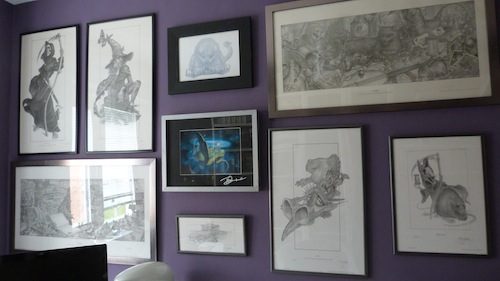
The pictures above are for enjoyment only. Although always a fan, I didn’t realise how much I’d come to adore Terry Pratchett’s work until I heard of his illness and, subsequently, his death. All but one of these pictures are official (and the odd one for my pleasure only, added because I loved it so much). This is a new house, a fresh start, and I drove my other half crazy getting him to hang these as I wanted.So…say a few words about your routine, they said. If only I had one! I’ve tried various regimens.
Write until I’m exhausted, never a great plan. Stick to a minimum number of words able to walk away self-satisfied and smug because I’ve got at least that amount of work accomplished. Or write as the muse dictates. Truth is, there is no correct choice. It’s a question of finding what works, and like all designs, sometimes life gets in the way and a change is necessary.
I used to like to write first thing in the morning. I came to struggle with that because I always worried I neglected something, maybe an important email. I try to quickly check email and do a pass through some type of social media early now, so at least it’s not nagging at me. So distracting!
If I have the opportunity I try to write a couple of hours in the morning and a couple early afternoon. If not, then I’ll write when and where necessary. I can work if there’s a television on in the room as long as it’s not a show I’m interested in, but I don’t tend to cope well with music playing. I’ve written during a journey or while visiting relatives. I’ve written for ten minutes or ten hours. Routine…it’s a wonderful dream.
My desk does not look interesting, though I can lower it or raise it as I want so I can choose to sit or stand, a better option then being glued to the seat facing a deadline. It’s not always as bare as it looks in the picture mostly because ‘hubby’ puts papers on there for filing or attention. If I’m peeved, I may throw these underneath on the floor. Don’t worry, I’m joking…partly. I really do chuck some papers into a pile by my feet. Course, I’m always hoping the little guys to the right will help with the filing if not the writing. Hasn’t worked yet.

Death, Rincewind, Errol, Greebo, The Librarian and The Death of Rats all look down from around the Discworld while I work. These and the overcrowded bookshelves at my back are part of a world I love so much. They’re the part of me who loved The Beast because he gave Belle a library.
I write in many genres and I’m pleased to say the latest upcoming titles in the multi-authored Lethbridge-Stewart series (The Brigadier of Doctor Who fame) will include my book, A Very Private Haunting. http://www.candy-jar.co.uk/books/lethbridgestewarthome.html
My first foray into this universe is available now on Kindle in the short story, The Wishing Bazaar.
Monday, November 13, 2017
Interesting article
Interesting item on covers for horror films that could as easily apply to artwork for books.
Monday, October 30, 2017
Happy Halloween?
Some might call wishing someone Happy Halloween an oxymoron. Readers of less dark fiction may well be surprised to hear how much I love Halloween and so many things spooky.
In keeping with the season, I thought to leave you a little scare this week. Some will find this funny, some may jump. Everyone's reaction is different. My question is always how many times would anyone keep flicking off the light?
In keeping with the season, I thought to leave you a little scare this week. Some will find this funny, some may jump. Everyone's reaction is different. My question is always how many times would anyone keep flicking off the light?
Monday, October 23, 2017
The Grimm Truth
I wrote this article for a West Country
community newsletter that I used to contribute to regularly.
Subsequently, this piece was also accepted for publication by Gothic Fairy Tales.
However, little was I to know that its publication in a small Devon
paper would result in my receiving fan mail…all the way from South
Africa! A North Devon ‘maid’ (as they are often referred to) had moved
all that way but continued to pay for and receive local news as a
reminder of her true home and the place where her heart lies. She simply
adored The Grimm Truth and wanted to thank me for writing it.
No one could have been more surprised and delighted than I. Until I
began writing novels this was my first instance of anyone outside of the
UK reading my work. Who was to know that a simple article would travel
such a long way?
*****
It may surprise many to know that the stories we now regard as created for and belonging to children were originally intended for adults only. They were often traditional folk tales with endings that were far more bloodthirsty than their modern-day counterparts. No one saved granny or the little girl in the red hood from the wolf’s ‘great big teeth’ and Sleeping Beauty was not awakened by a kiss, but impregnated by the prince, and even gave birth while still she slept. These stories speak of mysterious times and places, yet they are a tool to reflect incidences in our own lives and history. It was during the Victorian era that these stories began to be rewritten, printed, and delegated to the realm of children’s imagination. However, maybe in this they still serve their purpose for when read to children now, parents are unconsciously teaching their offspring that bad things happen in life, that we have to learn to deal with them, and that with a little luck and maybe perseverance the good guy can still win. Simply, these stories now teach us at an increasingly young age of the world in which we live, and they should not be regarded lightly or dismissed.
A well-known producer of collectable figurines clearly saw the potential of delving into these fantasies and tapping into the darker origins for adults. Consequently, a small series of figurines depicting these story characters combined with the macabre and Gothic, a soupcon of humour and eroticism hit the market as their response. Certainly not to everyone’s taste, a brief mention is not to publicise them, but to draw attention to the fact that these stories are still with us, and their influence remains as strong. In addition, these strange figures delved slightly out of the realm of fairy tales into the neighbouring text of nursery rhymes, these ditties that are regularly told to children of an even younger age. Indeed, some encyclopaedias classify them as verses for children.
Reminded of childhood reminiscences, I particularly recalled a book given to me by my grandmother containing works of the Brothers Grimm who collected stories as a study of their culture. Conversely, Hans Christian Anderson wrote his own stories, though he readily incorporated elements from the world around him. The Brothers were unhappy to find their work often referenced to children as they intended these tales for all. This was a contention they shared with Anderson, though their tales were sometimes considered coarse, while Anderson’s were often moralistic.
Knowing most fairy tales were not originally intended for younger audiences left the question of nursery verses and the origins and original intentions behind these short, entertaining rhymes. Choosing one for research purposes led to some interesting and equally entertaining information and equally if not more disturbing answers.
A few of us may be aware that Ring Around the Rosies was an account of the black plague and referred to the circles that occurred around the eyes; this ends unsurprisingly with people ‘falling down’ (dead). Conversely, how many of us remember Peter, Peter, Pumpkin Eater? How many of us would be content to read this to our children knowing that the origins are from America instead of Europe, though this may seem obvious since pumpkins were not readily available in England until recent years? Not much to concern anyone there even with the Pumpkin’s connotations of Halloween. Yet, how many of us would happily sit down to read this rhyme to children knowing what the verse actually meant. “Peter, Peter, Pumpkin Eater had a wife and couldn’t keep her” translates into an unfaithful wife; hence, he couldn’t ‘keep’ her. He put her in a pumpkin shell (pumpkin shell in this instance meaning chastity belt) and there he kept her very well.
Incidentally, the face carved in the Pumpkin is to frighten bad spirits away: it is not a bad entity itself. Another frequent mistake: children are not meant to trick you if they do not give them a treat. They are meant to ask for you to give them a treat or for you to play a trick on them: more examples of where traditions have been twisted to suit this modern age. So adults enlightened, children beware!
The truth is many of the rhymes that we once laughed over at bedtime were written using fact, even politics. Many were folk songs or even prayers; many rhymes were direct digs at greed and taxation. Some may have traditional customs. They may also be categorised as lullabies, riddles and tongue twisters among others. All had individual use and intended audience (counting rhymes are an effective aid to learning). Many are synonymous with other cultures though they may appear in a different form or with a substitute character relevant to that country’s history.
Some do not hold up so well in today’s climate. The tale of Miss Muffet, supposedly based on the daughter of an entomologist named Muffet who was frightened by one of her father’s spiders surely helps to instil fear in children of arachnids. Likewise, Peter Pumpkin Eater is seen by some as a form of abuse and the vision of a blind woman running after three mice with a chopper in her hand would be a strange sight for most of us. However, surely it is important to keep these in the context they have been regarded for decades. Once heard as children they became part of our play, have remained constant companions and did us less harm than most images youngsters are subject to today. The sad truth is some of these rhymes have changed over time and may not reflect their original intention. Alas, some origins are lost to us completely and the creators, many of them anonymous, are no longer with us. Still, they should not be discarded. Not many of us look back on them with any emotion other than a fondness. They are an integrated part of our history and, most importantly, they teach us to play with words at an early age.

© All rights reserved.
Monday, October 16, 2017
Of Fairy Tales and Lost Things
In keeping with the season, I thought I'd rehash (and tweak) an old review of The Book of Lost Things by John Connolly. No doubt better known for his crime novels, this may suggest a peculiar departure for the writer, but if so one he more than adequately explains in the last quarter of the book. This he dedicates to a discussion of the underlying themes and stories that have influenced him during his life, including their origins and a delightful reintroduction to, and the inclusion of, a few of these stories themselves. He incorporates these into the book expertly and chooses a style that is reminiscent of the rhyme and rhythm of those fairy tales that for most of us were the first introduction to story-telling.
In so doing he initially confused me, not because I didn't understand his intention but because, as a writer, I couldn’t see the market from a publisher’s point of view. Clearly I enjoyed it and I could envision many adults doing likewise, yet initially, I could see this being a book many publishers often reject as seeing ‘no market for this type of thing’. This is not a book for children although a book that children of a particular age could read and doubtless gain from the experience. I agree with the author that an adult will likely read this in a very different light to that of a child. This makes The Book of Lost Things one of those novels that may need re-reading at a different stage in one's life, possibly for the young adult and then as a mature one. I was pleasantly surprised to come across such a book for an audience of many ages, because of the writing ‘rule’ that dictates if the lead in a book is a child then it's a children’s book.
This is most definitely a book for adults to enjoy, not solely because of the surprisingly bloodthirsty content. It’s amazing how many of us forget how dark, foreboding, and just plain violent those old fairy tales that we grew up with and loved so well indeed were. I didn’t need the book’s added sojourn through the world of fairy tales to know that in many versions of Sleeping Beauty she awakens while giving birth, or the wicked queen in Snow White is made to wear red-hot iron ‘slippers’ to dance in until she dies, just as I know that in Cinderella birds flew down to pluck out her stepsisters’ eyes. Fairy tales have always held great interest for me and have influenced my work. Indeed, my twisted semi-erotic story Rose Light is a retelling of Cinderella. Admittedly I had to heighten sexual content to satisfy the publisher who released it under a romance banner, but it's a story that I intend to one day restore to its original form for a darker market. So nothing in the content of Connolly’s book surprised me. Nevertheless, I was amazed to find a book published that kept to the traditions of these stories and celebrating their content, of change, of choice, of triumphant, if often in a gruesome way.
Ultimately the strongest depth and substance to the book is grief, and loss, and how it changes us, becomes a part of who we are and, like stories, influences our lives. Overall because these are a ‘fairy tales’, they resonate in the way good stories should.
In so doing he initially confused me, not because I didn't understand his intention but because, as a writer, I couldn’t see the market from a publisher’s point of view. Clearly I enjoyed it and I could envision many adults doing likewise, yet initially, I could see this being a book many publishers often reject as seeing ‘no market for this type of thing’. This is not a book for children although a book that children of a particular age could read and doubtless gain from the experience. I agree with the author that an adult will likely read this in a very different light to that of a child. This makes The Book of Lost Things one of those novels that may need re-reading at a different stage in one's life, possibly for the young adult and then as a mature one. I was pleasantly surprised to come across such a book for an audience of many ages, because of the writing ‘rule’ that dictates if the lead in a book is a child then it's a children’s book.
This is most definitely a book for adults to enjoy, not solely because of the surprisingly bloodthirsty content. It’s amazing how many of us forget how dark, foreboding, and just plain violent those old fairy tales that we grew up with and loved so well indeed were. I didn’t need the book’s added sojourn through the world of fairy tales to know that in many versions of Sleeping Beauty she awakens while giving birth, or the wicked queen in Snow White is made to wear red-hot iron ‘slippers’ to dance in until she dies, just as I know that in Cinderella birds flew down to pluck out her stepsisters’ eyes. Fairy tales have always held great interest for me and have influenced my work. Indeed, my twisted semi-erotic story Rose Light is a retelling of Cinderella. Admittedly I had to heighten sexual content to satisfy the publisher who released it under a romance banner, but it's a story that I intend to one day restore to its original form for a darker market. So nothing in the content of Connolly’s book surprised me. Nevertheless, I was amazed to find a book published that kept to the traditions of these stories and celebrating their content, of change, of choice, of triumphant, if often in a gruesome way.
Ultimately the strongest depth and substance to the book is grief, and loss, and how it changes us, becomes a part of who we are and, like stories, influences our lives. Overall because these are a ‘fairy tales’, they resonate in the way good stories should.
Monday, October 02, 2017
Thanks for the memories, James
As it's October I thought it suitable to mention a writer who has 'been with me' since my teens. True, one of the first horror books I ever read was by Stephen King. The book was Salem's Lot if anyone is wondering. But for a long time, my favourite 'horror writer' was James Herbert. When I heard of his death, I experienced that jaw-dropping moment when one doesn't want to believe the news and can remember the moment as though it happened this morning.
I place the term 'horror writer' in quotes because Herbert was never entirely happy with being categorised, and had his share of mixed reviews. He felt any violent or horror-related work met a certain brand of snobbery. It's a problem I completely understand and why I label my own horror writing as Dark Fiction, precisely because many stories flank other topics and genres.
Some horror writers aren't, truly, writing what I call horror even if there's an element of that in the story. Some of Herbert's work became blended with the paranormal (he said himself that his later works tended to lean to the supernatural), fantasy, and I have always felt a large part of his compositions contained humanitarian questions and shone an ugly reflection on society. In Herbert's own words, some of what he had to say regarding his motivations and underlying themes might surprise many.
I recall one particular mention of the seemingly oversized rats in his books Rats, Lair, and Domain. The trilogy may have been inspired by a line in Dracula, but the description and size of the rodents came from the creatures he saw in the overrun areas of the East End of London in which he grew up. Having seen 'Rodents of Unusual Size' (some readers will know where I borrowed that from and it's not Herbert), I'm prepared to believe. Some can look bigger or at least match the size of small dogs.
There's also the issue of how much is too much? Yes, violence (and sex) can be gratuitous but I've also believed a writer should 'write' and not fear to show something as it is or would be. Herbert wasn't a writer who feared to call a 'spade a spade' and preferred to give an honest portrayal of any scene. Of course, his writing, which was ignored or even banned when first published is thought of as more commonplace now. Books and films deemed once to be adult viewing can now be found in school libraries.
Some readers will be surprised that I read or even like the horror genre, despite my saying constantly that I read anything and everything. Truth is, I grew up on horror books. My teen years were romances (usually Mills & Boon because that was what my friends were reading), Herbert, King, and Steinbeck. I'm serious when I say my library is eclectic.
I suppose in a sense I also admired Herbert because he was a success story -- well known and British. The young writer in me couldn't help being a little envious. So much happened to me throughout those years. My life went through so many changes. What I read during that time is blended with all the other memories. Lately, I've felt the pull to return to those roots with my writing. Though to date, it's been strictly short stories, I plan to try my first Dark Fiction novel soon and I'm sure I'll be thinking of Herbert when I do.
My tribute will be a simple one: many, many thanks for the memories, James.
I place the term 'horror writer' in quotes because Herbert was never entirely happy with being categorised, and had his share of mixed reviews. He felt any violent or horror-related work met a certain brand of snobbery. It's a problem I completely understand and why I label my own horror writing as Dark Fiction, precisely because many stories flank other topics and genres.
Some horror writers aren't, truly, writing what I call horror even if there's an element of that in the story. Some of Herbert's work became blended with the paranormal (he said himself that his later works tended to lean to the supernatural), fantasy, and I have always felt a large part of his compositions contained humanitarian questions and shone an ugly reflection on society. In Herbert's own words, some of what he had to say regarding his motivations and underlying themes might surprise many.
I recall one particular mention of the seemingly oversized rats in his books Rats, Lair, and Domain. The trilogy may have been inspired by a line in Dracula, but the description and size of the rodents came from the creatures he saw in the overrun areas of the East End of London in which he grew up. Having seen 'Rodents of Unusual Size' (some readers will know where I borrowed that from and it's not Herbert), I'm prepared to believe. Some can look bigger or at least match the size of small dogs.
There's also the issue of how much is too much? Yes, violence (and sex) can be gratuitous but I've also believed a writer should 'write' and not fear to show something as it is or would be. Herbert wasn't a writer who feared to call a 'spade a spade' and preferred to give an honest portrayal of any scene. Of course, his writing, which was ignored or even banned when first published is thought of as more commonplace now. Books and films deemed once to be adult viewing can now be found in school libraries.
Some readers will be surprised that I read or even like the horror genre, despite my saying constantly that I read anything and everything. Truth is, I grew up on horror books. My teen years were romances (usually Mills & Boon because that was what my friends were reading), Herbert, King, and Steinbeck. I'm serious when I say my library is eclectic.
I suppose in a sense I also admired Herbert because he was a success story -- well known and British. The young writer in me couldn't help being a little envious. So much happened to me throughout those years. My life went through so many changes. What I read during that time is blended with all the other memories. Lately, I've felt the pull to return to those roots with my writing. Though to date, it's been strictly short stories, I plan to try my first Dark Fiction novel soon and I'm sure I'll be thinking of Herbert when I do.
My tribute will be a simple one: many, many thanks for the memories, James.
Monday, September 25, 2017
Lethbridge-Stewart Series Five Announced
PRESS RELEASE 18/09/2017
LETHBRIDGE-STEWART
SERIES FIVE ANNOUNCED
SERIES FIVE ANNOUNCED

Series five opens with The New Unusual by first-time novelist, Adrian Sherlock, who wrote the short story, The Playing Dead, in 2016.
It is followed by A Very Private Haunting by Sharon Bidwell, who is no stranger to writing novels, with quite a resume behind her, including the Lethbridge-Stewart short story, The Wishing Bazaar in 2016.
The series is wrapped off with The Man from Yesterday, by popular novelist Nick Walters, who returns with his much-anticipated second novel in the Lethbridge-Stewart series, following 2015’s Mutually Assured Domination.
Range Editor Andy Frankham-Allen says: “It’s quite an exciting series, with three very distinctively different stories. Each explores very different aspects of the Lethbridge-Stewart universe. A New-Age thriller taking the team to Australia, a ghost story set in and around a haunted manor, and an all-out adventure which pits very branches of Lethbridge-Stewart’s family against each other.”
The New Unusual sees our heroes being drawn to Australia after investigating strange goings-on at dream-ins, mysterious new age gatherings in which people explore their deepest desires through eggs of alien origin. This book features the return of Lethbridge-Stewart’s nephew, Owain.
A Very Private Haunting sees Arthur Penrose finally take ownership of a Scottish manor house that’s been in his family for generations. There are many secrets in the house, but what connects them to the mysterious shadow creatures that Lethbridge-Stewart and his men are investigating?
The Man from Yesterday sees Lethbridge-Stewart learn the truth behind his father’s disappearance at the end of World War II, when aliens arrive on Earth from a mysterious region of space known only as the Realm. This book features the return of Lethbridge-Stewart’s brother from another reality, James Gore, and his father, Air Commander Gordon Lethbridge-Stewart!
Andy continues: “This series of books sees our lead characters, in particular Lethbridge-Stewart and Anne Travers, dealing with the fallout from the losses they suffered in series four. The series ends on something of a cliffhanger, which will have repercussions for the series as a whole for a long time.”
Head of Publishing Shaun Russell says: “Series five is the last in the ongoing series for a while, as next year we’re stepping out of the usual narrative to present a special series of novels celebrating fifty years of Alistair Lethbridge-Stewart and Anne Travers.”
The New Unusual, A Very Private Haunting and The Man from Yesterday are all available for individual pre-order now, for £8.99 (+ p&p). Or you can pre-order them as part of the discounted UK bundle for only £26.25 (including postage), saving £9.72, or an international bundle for only £45.00 (including postage), saving £5.97. Or, you can buy it as part of our yearly subscription offer. Order early to avoid disappointment.
-END-

For more information, or to arrange an interview with the editor, authors, cover artist and/or license holder, please contact Shaun Russell at shaun@candyjarbooks.co.uk or 02921 15720
Previous series:
Lethbridge-Stewart series 1:
The Forgotten Son by Andy Frankham-Allen
The Schizoid Earth by David A McIntee
Beast of Fang Rock by Andy Frankham-Allen
Mutually Assured Domination by Nick Walters
Lethbridge-Stewart series 2:
Moon Blink by Sadie Miller
The Showstoppers by Jonathan Cooper
The Grandfather Infestation by John Peel
Lethbridge-Stewart series 3:
Times Squared by Rick Cross
Blood of Atlantis by Simon A Forward
Mind of Stone by Iain McLaughlin
Lethbridge-Stewart series 4:
Night of the Intelligence by Andy Frankham-Allen
The Daughters of Earth by Sarah Groenewegen
The Dreamer’s Lament by Benjamin Burford-Jones
Monday, September 04, 2017
Death Note Dismay
Netflix’s effort to create a live-action adaption of the Japanese Manga series Death Note (first serialised in magazine form and later as anime and then live-action television) is overall disappointing.
I dislike when the conception of a character changes, so in that regard would like the opportunity to see the live-action film released in Japan in 2006/8, and while the relocation might call for altered nationalities, I would have preferred a cast reflecting the original personas more. Not that there is anything wrong with the performances of the actors giving the story line and the limited time to execute it — and there lies the real problem, as I will explain further on.
It's sad the cast does their best with limited material. In this revamp, Nat Wolff fits the lead role of Light (Yagami), and Margaret Qualley the lead female, Mia — a necessary change for the better. The anime characteristics of the earlier ‘Misa’ (who is erratic and immature) would never fully translate to a western culture. She was the most irritating female protagonist/antagonist (she reflects both at various times in the plot) I’ve seen in a long time.
In particular, although Lakeith Stanfield did a good job of perfecting the glances and mannerisms of ‘L’ the character dissolves into volatile instability in a way the original ‘L’ (Ryuzaki) never did, and it’s a shame they took his personality in that direction.
Ryuzaki’s story in the anime was expected and logical but no less onerous for all that and ‘L’ remains for me the most compelling character of the whole series and concept so I would have liked to see everything about the adaption more fledged. The interplay between Light and Ryuzaki is lacking in the Netflix edition, which at heart is not in any way captivating, or inspiring conviction.
The best thing may well be Ryuk as voiced by Willem Defoe, but I was sorry the whole mythology of the Shinigami wasn’t explained to the uninitiated, and the skilful twists of the plot compacted to such a momentary suggestion of the source material. I’ve read criticism that the film feels rushed and I wholeheartedly agree. The sheer haste of execution means none of the sub-text is examined and barely disclosed. I recommend checking out the anime series though for a serial running for 37 episodes it requires commitment.
I dislike when the conception of a character changes, so in that regard would like the opportunity to see the live-action film released in Japan in 2006/8, and while the relocation might call for altered nationalities, I would have preferred a cast reflecting the original personas more. Not that there is anything wrong with the performances of the actors giving the story line and the limited time to execute it — and there lies the real problem, as I will explain further on.
It's sad the cast does their best with limited material. In this revamp, Nat Wolff fits the lead role of Light (Yagami), and Margaret Qualley the lead female, Mia — a necessary change for the better. The anime characteristics of the earlier ‘Misa’ (who is erratic and immature) would never fully translate to a western culture. She was the most irritating female protagonist/antagonist (she reflects both at various times in the plot) I’ve seen in a long time.
In particular, although Lakeith Stanfield did a good job of perfecting the glances and mannerisms of ‘L’ the character dissolves into volatile instability in a way the original ‘L’ (Ryuzaki) never did, and it’s a shame they took his personality in that direction.
Ryuzaki’s story in the anime was expected and logical but no less onerous for all that and ‘L’ remains for me the most compelling character of the whole series and concept so I would have liked to see everything about the adaption more fledged. The interplay between Light and Ryuzaki is lacking in the Netflix edition, which at heart is not in any way captivating, or inspiring conviction.
The best thing may well be Ryuk as voiced by Willem Defoe, but I was sorry the whole mythology of the Shinigami wasn’t explained to the uninitiated, and the skilful twists of the plot compacted to such a momentary suggestion of the source material. I’ve read criticism that the film feels rushed and I wholeheartedly agree. The sheer haste of execution means none of the sub-text is examined and barely disclosed. I recommend checking out the anime series though for a serial running for 37 episodes it requires commitment.
Monday, August 14, 2017
Experience something bitter, something intoxicating
2011? How was this 2011? Seems like yesterday and still one of my favourite stories because I got the writing and story just as I wanted. Thinking of including it in a collection.
I also remember sshhhing the husband while putting on the final polish. My inspiration was the title of the anthology and the 'Green Muse' painting by French history painter and illustrator, Albert Pierre René Maignan.
Émile beheld the rough lines of age and labour in the hand before him. The network of passing years bisected by a scar and punctuated by torn cuticles threatened to entrap him in a labyrinth of wanting. If only he could capture the essence of that hand, the person it belonged to, in a drawing.
I also remember sshhhing the husband while putting on the final polish. My inspiration was the title of the anthology and the 'Green Muse' painting by French history painter and illustrator, Albert Pierre René Maignan.
***
Bitter and Intoxicating
Monday, August 07, 2017
Where the Spirit of the Wolf and the Fox meet
That is in my short story 'The Wolf Moon' and 'Fox Spirit' books in their anthology 'Winter Tales', which appeared early 2016. When I saw the submission call, I instantly knew which story to send. 'The Wolf Moon' is one of a body of work, thirteen short tales based around a theme, equally possible to read independently (I've published more than one with magazines), but would make an eerie collection. Fox Spirit was the perfect match for 'The Wolf Moon' one of the last written in an project that's taken me a few years from conception to completion.
Shortlisted for the Best Indie Press twice by the British Fantasy Society, Fox Spirit's mission statement summarises the belief that day to day life lacks a number of things, namely the fantastic, the magical, mischievous and a touch of the horrific. They aim to produce books 'full of wonder and mischief delivered with a sharp bite'. My short story definitely applies and I couldn't ask for a better springboard for a 'Kernow' tale.
Diana may or may not be a hunter, but Gabriel is no angel.
Excerpt:
Minutes ticked by, the hush fragmented by whispers. The door creaked open, muzzling free expression. Diana became aware of a large presence, prodigious in stature, colossal in self-possession. The longing to look was almost too much for her, made more difficult by other people’s reactions. The tide parted, made way for the newcomer even if that meant they must move closer to her.
Carver suddenly had a dilemma. He stopped in mid-flow on his way to her, gaze darting from the man standing in front of him and down to the end where Diana stood controlling the urge to smirk. He compromised—shoved her goods into the hands of his helper, nodded to the new arrival, and hurried out back to get whatever he’d come for. Diana took her time placing the items in her basket, although there were only two, and only the small sack of flour was cumbersome. As she turned to leave she tried to make the act of lifting her head look natural, the direction of her gaze an accident or coincidence.
See me.
By wish or bewitchment, he did. Man and woman gazed at each other. She saw blue eyes so bright as to illuminate the darkness like moonlight, a head of shaggy peppered hair, dark stubble along a strong jaw, and muscle. Hunter and hunted. Diana suppressed a shudder.
Without pause, she completed the turn and headed to the door. Remarks followed.
‘Witch,’ one woman said, following up her pronouncement with spittle. Diana smirked at the thought of Carver having to wash the floor, ignored her, and enjoyed the woman’s confusion.
‘Those raised by wolves should stay in the wild,’ another said. Diana agreed and breathed in relief as the cold of the day held out its welcoming arms. She plunged into snow and freedom.
Shortlisted for the Best Indie Press twice by the British Fantasy Society, Fox Spirit's mission statement summarises the belief that day to day life lacks a number of things, namely the fantastic, the magical, mischievous and a touch of the horrific. They aim to produce books 'full of wonder and mischief delivered with a sharp bite'. My short story definitely applies and I couldn't ask for a better springboard for a 'Kernow' tale.
Diana may or may not be a hunter, but Gabriel is no angel.
Excerpt:
Minutes ticked by, the hush fragmented by whispers. The door creaked open, muzzling free expression. Diana became aware of a large presence, prodigious in stature, colossal in self-possession. The longing to look was almost too much for her, made more difficult by other people’s reactions. The tide parted, made way for the newcomer even if that meant they must move closer to her.
Carver suddenly had a dilemma. He stopped in mid-flow on his way to her, gaze darting from the man standing in front of him and down to the end where Diana stood controlling the urge to smirk. He compromised—shoved her goods into the hands of his helper, nodded to the new arrival, and hurried out back to get whatever he’d come for. Diana took her time placing the items in her basket, although there were only two, and only the small sack of flour was cumbersome. As she turned to leave she tried to make the act of lifting her head look natural, the direction of her gaze an accident or coincidence.
See me.
By wish or bewitchment, he did. Man and woman gazed at each other. She saw blue eyes so bright as to illuminate the darkness like moonlight, a head of shaggy peppered hair, dark stubble along a strong jaw, and muscle. Hunter and hunted. Diana suppressed a shudder.
Without pause, she completed the turn and headed to the door. Remarks followed.
‘Witch,’ one woman said, following up her pronouncement with spittle. Diana smirked at the thought of Carver having to wash the floor, ignored her, and enjoyed the woman’s confusion.
‘Those raised by wolves should stay in the wild,’ another said. Diana agreed and breathed in relief as the cold of the day held out its welcoming arms. She plunged into snow and freedom.
***
Frost pierces through everything. Your bones ache in the icy wind.
Harsh winter storms rage and the sun is leaving, not to return for many
months. The cheerful men arriving to the mountain bothy in the midst of
the winter storm, why do they unnerve you so much? The hunter who
follows after you on your way home from the store, what does he hunt?
The old neighbour lady seems so innocent, but you know the truth: you
saw her that night. Why will the police not listen to you?
Dark, grim, beautiful and grotesque. We are delighted to bring you a collection of speculative winter stories and poems from new and established writers. The collection is edited by Margret Helgadottir. Winter Tales released early 2016 from Fox Spirit Books.

Cover art is by S.L. Johnson
Monday, July 24, 2017
Not so lovable Groot
Guardians of the Galaxy is one of my favourite films. While I didn't adore the second installment, I still found much to enjoy, but the trouble with any follow-up is the level of expectation and the pressure to surpass that first experience. It's a problem every creative person understands too well.
That's not the subject of this post. Most of us love Groot, but did you know he wasn't always the adorable character you may think you know and love?
That's not the subject of this post. Most of us love Groot, but did you know he wasn't always the adorable character you may think you know and love?
Monday, June 26, 2017
Bad Sex Award
Many have heard of the yearly Bad Sex in Fiction Award, which has been going since 1993 -- the purpose to 'honour' an author for producing an 'outstandingly' bad sexual scene in what might otherwise be an excellent novel. The prize doesn't include erotic fiction and mainly exists to throw light on often unnecessary sections of sex given a superficial treatment.
This is part of an old post where I drew attention to the 17th Annual Bad Sex in Fiction Award that went to author Jonathan Littell for some hilarious passages in his novel The Kindly Ones. However, some of the sentences aren't as good/bad as they've been in some years and this is a translation from the French, which can affect some meanings. It's also difficult judging for oneself when reading these lines out of context. Read more on the book and the award at BBC News.
Cringe worthy? Spiteful? Personally, I think it would be a fun award to win and, as they say, any publicity is good, although I'm not sure that's always entirely true.
However, this I wish to put forward my own contender/winner even though it's for a book published some years ago:
"She kept a secret spring surrounded by sweet moss, and there he was refreshed."
And the winner is...
Stephen King for this line in his 5th Dark Tower novel 'Wolves of the Calla'. It does read slightly better in context but made me roar with laughter so unless that was his intention (and even if it was) this has got to be a dodgy euphemism if ever I heard one. Otherwise, I love the Dark Tower series and finally got to read the whole series in one sitting. I love the character of Roland but my hero is Eddie.
I'm going to keep the award in mind when constructing such sentences.
This is part of an old post where I drew attention to the 17th Annual Bad Sex in Fiction Award that went to author Jonathan Littell for some hilarious passages in his novel The Kindly Ones. However, some of the sentences aren't as good/bad as they've been in some years and this is a translation from the French, which can affect some meanings. It's also difficult judging for oneself when reading these lines out of context. Read more on the book and the award at BBC News.
Cringe worthy? Spiteful? Personally, I think it would be a fun award to win and, as they say, any publicity is good, although I'm not sure that's always entirely true.
However, this I wish to put forward my own contender/winner even though it's for a book published some years ago:
"She kept a secret spring surrounded by sweet moss, and there he was refreshed."
And the winner is...
Stephen King for this line in his 5th Dark Tower novel 'Wolves of the Calla'. It does read slightly better in context but made me roar with laughter so unless that was his intention (and even if it was) this has got to be a dodgy euphemism if ever I heard one. Otherwise, I love the Dark Tower series and finally got to read the whole series in one sitting. I love the character of Roland but my hero is Eddie.
I'm going to keep the award in mind when constructing such sentences.
Monday, June 19, 2017
A Life Lesson Learned
I’ve had more than one run-in with ‘celebrity’, but this incident was my first. A few years ago I was working in an office and answered the phone. When I realised with whom I was speaking, I experienced a ‘gulp’ moment where time slowed enough for ‘I really don’t want to be dealing with this’ to pass through my mind. I had heard enough ‘rumours’ to square my shoulders and straighten my spine, preparing for a not-very-nice-guy. Still, I am, if nothing else, generous, prepared to give anyone the benefit of the proverbial doubt...in this particular instance short lived. The moment of good grace passed with the first words to come out of his mouth, the ‘conversation’ something like this:
“Get ****** *******.”
“I’m sorry, she’s not at her desk right...”
“I want to speak to her.”
“... now. Maybe I can help, or take a message?”
“I am ******* **** so Go.Get.Her.Right.Nowwwwww.”
My cognitive reasoning instantly translated this to: “I’m a toffee-nosed blowhole who expects the world to bow instantly to my every whim. I’m so full of my own self-importance, I kiss my reflection first thing in the morning and last thing at night because no one else is good enough to kiss me, at all...except maybe my feet, when they are down there grovelling.”
I went to fetch the person in question (the toilet of all places) because it was my job and because, unfortunately, she was the other side of a similar coin. They deserved working together. She had the art of obsequiousness down pat when it served. Alas, in the real world, people management escaped her skillset.
“You got the photocopying done?” she asked one morning, staring at the pile in my arms. “You got it done ‘today’?”
“Yes,” I replied, somewhat puzzled.
“However did you manage that? ***** never does the photocopying for me that quickly. She sometimes makes me wait days.”
To clarify, some offices have had a photocopying departments, particularly if a lot of duplicate documents or leaflets were regularly sent out.
How did I get my photocopying done in a blink where this other person couldn’t? Compare her, “Get this done,” to my “Good morning, *****. How are you today? How’s your daughter?” In reply, I’d listen (and I do mean pay attention) to how well the woman’s daughter was doing, how proud she was of the young girl’s latest achievements, all of which swiftly concluded with, “I’ll put your work up next.”
No, I did not wish this woman a good morning in order to get my photocopying. Her doing so was an amazing bonus, but that was not in my mind the first time I said hello, or when I asked how she was anytime after. It’s called respect and being polite. I didn’t see her as the ‘photocopying woman’ as did so many. I saw her as someone deserving the same regard as anyone — a lesson the other two people of this blog could have done with learning before anyone gave them a job.
No one is generally more important than anyone else. If I were famous I would not expect someone to hurry off the toilet barring a life or death situation (that call...was it important? No, not at all). I wouldn’t turn up without warning and expect to jump the queue. It’s a crazy world where a recognisable name or face expects preferential treatment, particularly if it’s to the detriment of others. It’s odd we bestow such care, not on a nurse who maybe saved a life that day, but on people (famous, or not) who treat others with rudeness and arrogance. Respect should be earned. The person who does the photocopying or served coffee that morning, are all the same. My father served coffee for a time, and though he might have ended up in the Tower of London, had the Queen turned up he would have expected her to pay and to wait in line. He would have been polite, he would have been respectful, but he did not like any individual having privilege over another. Maybe the picture he painted with this declaration was more allegorical than actual, but, as a child, that was something I would have been tickled to see. I never knew if he exaggerated, but the principle sure stuck in my mind.
“Get ****** *******.”
“I’m sorry, she’s not at her desk right...”
“I want to speak to her.”
“... now. Maybe I can help, or take a message?”
“I am ******* **** so Go.Get.Her.Right.Nowwwwww.”
My cognitive reasoning instantly translated this to: “I’m a toffee-nosed blowhole who expects the world to bow instantly to my every whim. I’m so full of my own self-importance, I kiss my reflection first thing in the morning and last thing at night because no one else is good enough to kiss me, at all...except maybe my feet, when they are down there grovelling.”
I went to fetch the person in question (the toilet of all places) because it was my job and because, unfortunately, she was the other side of a similar coin. They deserved working together. She had the art of obsequiousness down pat when it served. Alas, in the real world, people management escaped her skillset.
“You got the photocopying done?” she asked one morning, staring at the pile in my arms. “You got it done ‘today’?”
“Yes,” I replied, somewhat puzzled.
“However did you manage that? ***** never does the photocopying for me that quickly. She sometimes makes me wait days.”
To clarify, some offices have had a photocopying departments, particularly if a lot of duplicate documents or leaflets were regularly sent out.
How did I get my photocopying done in a blink where this other person couldn’t? Compare her, “Get this done,” to my “Good morning, *****. How are you today? How’s your daughter?” In reply, I’d listen (and I do mean pay attention) to how well the woman’s daughter was doing, how proud she was of the young girl’s latest achievements, all of which swiftly concluded with, “I’ll put your work up next.”
No, I did not wish this woman a good morning in order to get my photocopying. Her doing so was an amazing bonus, but that was not in my mind the first time I said hello, or when I asked how she was anytime after. It’s called respect and being polite. I didn’t see her as the ‘photocopying woman’ as did so many. I saw her as someone deserving the same regard as anyone — a lesson the other two people of this blog could have done with learning before anyone gave them a job.
No one is generally more important than anyone else. If I were famous I would not expect someone to hurry off the toilet barring a life or death situation (that call...was it important? No, not at all). I wouldn’t turn up without warning and expect to jump the queue. It’s a crazy world where a recognisable name or face expects preferential treatment, particularly if it’s to the detriment of others. It’s odd we bestow such care, not on a nurse who maybe saved a life that day, but on people (famous, or not) who treat others with rudeness and arrogance. Respect should be earned. The person who does the photocopying or served coffee that morning, are all the same. My father served coffee for a time, and though he might have ended up in the Tower of London, had the Queen turned up he would have expected her to pay and to wait in line. He would have been polite, he would have been respectful, but he did not like any individual having privilege over another. Maybe the picture he painted with this declaration was more allegorical than actual, but, as a child, that was something I would have been tickled to see. I never knew if he exaggerated, but the principle sure stuck in my mind.
Monday, June 05, 2017
Shakespeare's Influence
Couldn't resist sharing. Think you know Shakespeare? Or maybe you think you've never read him, never watched a play, and don't care to. Maybe you think you don't know any Shakespeare at all. Think again.
Love or loathe, Shakespeare influenced our language like no other writer. My personal tip is, if you can, visit The Globe (or any theatre) and watch a live performance. His work are plays and meant to be watched rather than read. The Merchant of Venice was one of the many fantastic performances I've seen, and yes, I was lucky enough to see it at The Globe on a balmy summer evening. Watch for a fast and fun whirlwind tour of how Shakespeare has influenced our lives:
Love or loathe, Shakespeare influenced our language like no other writer. My personal tip is, if you can, visit The Globe (or any theatre) and watch a live performance. His work are plays and meant to be watched rather than read. The Merchant of Venice was one of the many fantastic performances I've seen, and yes, I was lucky enough to see it at The Globe on a balmy summer evening. Watch for a fast and fun whirlwind tour of how Shakespeare has influenced our lives:
Monday, May 22, 2017
Amazon Shenanigans
This week I'm simply highlighting some more Amazon Shenanigans.
I, too, was fooled by cheap books in the beginning, but this
steamroller is now out of control, and is no less damaging. Alas, some
writers and even publishers have to rely on Amazon these days, but
they've done nothing for writers or the book industry overall. I'm not
telling anyone what to do, or where to buy, and in some cases there is
literally 'no choice' but, please, open your eyes. Search online for
more related articles.
Monday, May 15, 2017
Love of the Written Word
This week, I'm re-blogging a post I wrote for one of my publisher's
blog (when I was writing for Musa). I think it's timely as the sale of
printed books are on the increase.
I’m here to discuss a friend's point of view -- one that hadn't occurred to me before. I’m going to wander a bit because I’m also talking books, but it all comes down to love for the written word.
Some people love e-books, some loathe them. I know some hate the term ‘e-book’ and I take that argument on board. A ‘book’ is a bound set of pages. Maybe it would be more accurate to call the electronic file of a book an e-novel or e-story because I don’t feel the presentation affects the content. The story ‘exists’ the moment the author penned it. When one used typewriters or even quills and ink, that didn’t make the story exist any less, although by no definition could hand written or typed pages be called ‘books’.
I'm not against electronic files of books, but I still love paper books. Always will. I admit there’s nothing like a physical book that can be held in the hand. It’s nostalgic. If a gift, we may recollect when we opened a brightly wrapped package, the moment we first set eyes on it, felt that fission of pleasure, and spare a moment’s thought for the person who gifted it. An electronic file, for the most part, lacks the personal touch. An old book, even when it deteriorates with time… Well, those creases in the spine and cover could have been put there over many years of handling and love. I don’t see a scruffy book as one that has necessarily been discarded or ill-used. Also, for someone like me who spends a great deal of time in front of computer screens, then the printed page is a departure from that, although e-readers are improving all the time and this may not always be an issue.
Saying that, there's room for both formats in my life simply owing to practicality. For one thing, I write e-books and would be a total hypocrite to then say I hate them. I don't hate them. I would love to live in the kind of library the Beast gave to Beauty in the Disney film -- just push my bed and a chair and table into the middle, I'll be fine -- but so far I’ve yet to stumble across any enchanted castles even if I’ve found my Prince Charming. I love all sorts of books from the classics to children’s stories, fantasy and horror, and yes, some romances. I can be fussy about my romances more than any genre, I think, but I do read them along with all the other genres I love -- to call my book collection eclectic is an understatement.
Unfortunately, I simply don’t have room for all the books I would love to read and own. I’m one of those readers, who, if I love a book, I struggle to part with it. I’ve relatives who don’t understand this. They feel a book once read or a film once seen is finished with. The story has been told; the reader/viewer knows what will happen, so why read/watch it again. I understand the point, but I disagree with it. A much-loved experience can be enjoyed again. It can be enjoyed more because often one can miss things on a first pass just as an author can during the writing process.
Among my many ‘wants’, I would love to own an entire library of classics. I’ve an abiding love for them. It amazes me when I hear someone say today that they’ve never read any of the literary greats. Black Beauty, Heidi, Pride and Prejudice, Gulliver’s Travels, Oliver Twist...all these books and more were among my childhood reads. I cannot even remember them being referred to as ‘classics’ -- they were just books and they were adventures. They took me to different worlds and gave me experiences I would never have had otherwise. I read them alongside stories such as The Water Babies, What Katy Did, Ballet Shoes, Charlie and the Chocolate Factory and I never differentiated. Now they are looked upon as stuffy, and dry, the language outdated. I cannot help feeling that people were better educated, more eloquent and literate when such books were read at a younger age. I was born at a time when almost all parents read to their children, where I was given books for older children than my age, and if I couldn’t read them right away, well I wanted to, and it made me strive to learn. If I didn’t know a word my parents handed me a dictionary and told me to look it up, and yes, I took the time to do so. So these books have remained with me, ingrained.
The electronic format has allowed me to revisit some of these classics I’ve lost through moves, through lack of space. I am grateful. They are adventures and memories revisited, and I can keep them in virtual ‘space’. Although I still often buy my favourite authors in print, I have branched out and discovered others owing to electronic formats. I would prefer a world where there wasn’t an argument for or against, but where all can live in support and cooperation. In an advanced society, life is about individual choice.
My thinking was personified when speaking with a friend of mine. This friend is in his seventies and he recently bought an e-reader...and adores it. His reason is simple -- he has struggled to read a book for some time. His eyes aren’t quite as they used to be and there may be other factors in his health, but whatever the reason, he can ‘see’ the words better on his reader as opposed to looking at a printed page. He can also increase the font size if need be, or zoom in. His reader has made his whole reading experience come alive again, and where he had as good as given up reading, or took a long time to struggle through a single novel, he’s reading again...devouring books, and what I saw in his eyes as he told me all this was joy.
So I’m just putting this thought out there for those very much against. Maybe e-books and e-readers aren’t for everyone, and for some, they may never be, but I think this proves that it’s pointless to criticise the needs of another person and that none of us can know what we may one day need ourselves. Should there be anyone saying they’d rather give up reading than commit sacrilege and read electronic books, then I can only think nose, spite, face. I could never give up reading. I’ve never heard such venomous arguments over audio books, which many people enjoy who aren’t blind and who don’t have seeing difficulties. The argument may stem from fear -- a dread that the production of printed books will one day cease, and I understand that emotion well. Without printed books, this would be a poorer world, but one cannot ignore the increase of electronic formats -- something I knew would take off long before the first e-reader was even conceived. Simply, there may come a time where e-readers exist alongside things like audio books and are considered as commonplace, where they’re a lifeline for some, and -- just as someone brought books into my life to enrich it -- in my ‘book’ that makes their existence tolerable and even worthwhile.
I’m here to discuss a friend's point of view -- one that hadn't occurred to me before. I’m going to wander a bit because I’m also talking books, but it all comes down to love for the written word.
Some people love e-books, some loathe them. I know some hate the term ‘e-book’ and I take that argument on board. A ‘book’ is a bound set of pages. Maybe it would be more accurate to call the electronic file of a book an e-novel or e-story because I don’t feel the presentation affects the content. The story ‘exists’ the moment the author penned it. When one used typewriters or even quills and ink, that didn’t make the story exist any less, although by no definition could hand written or typed pages be called ‘books’.
I'm not against electronic files of books, but I still love paper books. Always will. I admit there’s nothing like a physical book that can be held in the hand. It’s nostalgic. If a gift, we may recollect when we opened a brightly wrapped package, the moment we first set eyes on it, felt that fission of pleasure, and spare a moment’s thought for the person who gifted it. An electronic file, for the most part, lacks the personal touch. An old book, even when it deteriorates with time… Well, those creases in the spine and cover could have been put there over many years of handling and love. I don’t see a scruffy book as one that has necessarily been discarded or ill-used. Also, for someone like me who spends a great deal of time in front of computer screens, then the printed page is a departure from that, although e-readers are improving all the time and this may not always be an issue.
Saying that, there's room for both formats in my life simply owing to practicality. For one thing, I write e-books and would be a total hypocrite to then say I hate them. I don't hate them. I would love to live in the kind of library the Beast gave to Beauty in the Disney film -- just push my bed and a chair and table into the middle, I'll be fine -- but so far I’ve yet to stumble across any enchanted castles even if I’ve found my Prince Charming. I love all sorts of books from the classics to children’s stories, fantasy and horror, and yes, some romances. I can be fussy about my romances more than any genre, I think, but I do read them along with all the other genres I love -- to call my book collection eclectic is an understatement.
Unfortunately, I simply don’t have room for all the books I would love to read and own. I’m one of those readers, who, if I love a book, I struggle to part with it. I’ve relatives who don’t understand this. They feel a book once read or a film once seen is finished with. The story has been told; the reader/viewer knows what will happen, so why read/watch it again. I understand the point, but I disagree with it. A much-loved experience can be enjoyed again. It can be enjoyed more because often one can miss things on a first pass just as an author can during the writing process.
Among my many ‘wants’, I would love to own an entire library of classics. I’ve an abiding love for them. It amazes me when I hear someone say today that they’ve never read any of the literary greats. Black Beauty, Heidi, Pride and Prejudice, Gulliver’s Travels, Oliver Twist...all these books and more were among my childhood reads. I cannot even remember them being referred to as ‘classics’ -- they were just books and they were adventures. They took me to different worlds and gave me experiences I would never have had otherwise. I read them alongside stories such as The Water Babies, What Katy Did, Ballet Shoes, Charlie and the Chocolate Factory and I never differentiated. Now they are looked upon as stuffy, and dry, the language outdated. I cannot help feeling that people were better educated, more eloquent and literate when such books were read at a younger age. I was born at a time when almost all parents read to their children, where I was given books for older children than my age, and if I couldn’t read them right away, well I wanted to, and it made me strive to learn. If I didn’t know a word my parents handed me a dictionary and told me to look it up, and yes, I took the time to do so. So these books have remained with me, ingrained.
The electronic format has allowed me to revisit some of these classics I’ve lost through moves, through lack of space. I am grateful. They are adventures and memories revisited, and I can keep them in virtual ‘space’. Although I still often buy my favourite authors in print, I have branched out and discovered others owing to electronic formats. I would prefer a world where there wasn’t an argument for or against, but where all can live in support and cooperation. In an advanced society, life is about individual choice.
My thinking was personified when speaking with a friend of mine. This friend is in his seventies and he recently bought an e-reader...and adores it. His reason is simple -- he has struggled to read a book for some time. His eyes aren’t quite as they used to be and there may be other factors in his health, but whatever the reason, he can ‘see’ the words better on his reader as opposed to looking at a printed page. He can also increase the font size if need be, or zoom in. His reader has made his whole reading experience come alive again, and where he had as good as given up reading, or took a long time to struggle through a single novel, he’s reading again...devouring books, and what I saw in his eyes as he told me all this was joy.
So I’m just putting this thought out there for those very much against. Maybe e-books and e-readers aren’t for everyone, and for some, they may never be, but I think this proves that it’s pointless to criticise the needs of another person and that none of us can know what we may one day need ourselves. Should there be anyone saying they’d rather give up reading than commit sacrilege and read electronic books, then I can only think nose, spite, face. I could never give up reading. I’ve never heard such venomous arguments over audio books, which many people enjoy who aren’t blind and who don’t have seeing difficulties. The argument may stem from fear -- a dread that the production of printed books will one day cease, and I understand that emotion well. Without printed books, this would be a poorer world, but one cannot ignore the increase of electronic formats -- something I knew would take off long before the first e-reader was even conceived. Simply, there may come a time where e-readers exist alongside things like audio books and are considered as commonplace, where they’re a lifeline for some, and -- just as someone brought books into my life to enrich it -- in my ‘book’ that makes their existence tolerable and even worthwhile.
Monday, April 24, 2017
Perfect sentences
The power of a single sentence can make a whole book not only
memorable in the short term, but a forever favourite. The perfect
sentence (or paragraph) can be humourous, insightful, frightening,
heartbreaking, or a combination of these and many more. The right
sequence of words can convey a thought process, the whole subtext of a
novel, and/or make the reader look at the world a different way. I've
kept some novels simply because I felt the book contained a perfect
sentence, one that resonated. The writer cannot get too engrossed with
creating the correct phrase, however, because he or she would never
complete any work. Fortunately, for everyone, sometimes the magic
happens anyway, but one sentence that means the world to one reader will
be meaningless to another. All our experiences differ. As unique
individuals what we appreciate and what has meaning varies as much as
our personalities. Life would be boring if the situation were otherwise.
One such perfect sentence for me is toward the end of Poppy Z Brite's, Drawing Blood. "The art was in learning to spend your life with someone, in having the courage to be creative with someone, to melt each other's souls to molten temperatures and let them flow together into an alloy that could withstand the world."
This is perfect to me because it reveals the human condition, of the struggle to withstand and sustain life, and includes a simple but well-presented explanation of why for many of us we find it important to create and to love. We may not need books, music, art etc., or even require companionship to exist, but we need them to 'live'. The above sentence takes something fundamental to most of us and presents it in an untarnished, descriptive, and beautiful way.
One such perfect sentence for me is toward the end of Poppy Z Brite's, Drawing Blood. "The art was in learning to spend your life with someone, in having the courage to be creative with someone, to melt each other's souls to molten temperatures and let them flow together into an alloy that could withstand the world."
This is perfect to me because it reveals the human condition, of the struggle to withstand and sustain life, and includes a simple but well-presented explanation of why for many of us we find it important to create and to love. We may not need books, music, art etc., or even require companionship to exist, but we need them to 'live'. The above sentence takes something fundamental to most of us and presents it in an untarnished, descriptive, and beautiful way.
Monday, April 03, 2017
Regard Fear as the Enemy
A little over a year ago I did a guest spot on Southern Writers. Several months on this seems a perfect moment to reproduce that blog here, though an introduction explaining why won't hurt.
Writers everywhere get days when they would like nothing more than remain in bed, and to draw the pillow over their heads. Despite the longed-for dream, not everything about writing is fun. I always look at writing and publishing as two different 'beasts'. This is one of those not-so-fun instances.
I've moved. We've work to do in the house, and this being the biggest relocation of our lives (so far), we've much to organise. I'd love to be one of those people who can compartmentalise, push everything to the back of my mind and write. I'm much better at getting everything finished and then concentrating on one thing at a time. No way in publishing can that happen. Right now I've a book to finish I wanted to sub at the end of January. I've another in a trilogy that requires approximately another 20k of words and I should be sending in...oh about now. There's no set deadline, but I'm trying to reach readers, publisher, and my expectations. Then I've another, and in many ways far more important book to finish that needs a whole subplot adding to it. I'm swamped.
At the weekend I walked away from it all. I took a time out I couldn't afford because something was going to snap; bad enough it should be my temper but I didn't want it to be me. All that leads me into the subject because writers live with a good deal of fear. Fear they won't meet deadlines. Fear they won't be able to finish a book. Terror each new work won't be received as well as their last. Fear of taking on new projects, especially those outside of their comfort zone, and the temptation to walk away from it all.
While the books I refer to below are currently unavailable I'm working on other projects that feel as terrifying, maybe more so. Add to that the dread of days that end in what feels like a blink and bed and a pillow seems evermore enticing. The trouble with that temptation like so many types of avoidance, it cures nothing.
I wish I could write an encouraging ‘how-to’ narrative revealing all the secrets of mastering the writing craft. Such a missive might make the task easier and eliminate writer anxiety. My own included. My advice? Be afraid but grasp opportunities anyway.
The secret is there is no secret. What may work for one author may not work for another, same for genre or market. There’s no specific wrong or right way to write, wrong or right way to market (though spamming is never a good thing). There’s no yet to be revealed way to kill the worry of finding the next idea, the right publisher, receiving a bad review, or jumping in and trying something new. I’ve learned to view the occasional fluke as providence.
I try anything, and file that which doesn’t work now in case something becomes useful in the future. This goes for stories as much as promoting. I find stories often by ‘accident’. I’ll begin with two seemingly unconnected incidents, a vague idea of characters or places, or a single occurrence. I’ve even created stories from a title idea, a phrase, or a random selection of words, tried numerous genres. Some markets I stumbled into because an idea nagged me to write it, or because I was searching for submission calls. That’s when accident bridges the gap to intent. Where one formula won’t work for one writer, it may do so for another. Where a blueprint doesn’t apply to one genre, another must be rigid. Study the market. It’s amazing how many writers still send the wrong material to the wrong editor or publication. A horror publisher doesn’t want romance or vice versa. Pay attention to guidelines.
I read anything and everything; have too many interests, so when it came to writing it was hardly surprising I wanted to run in all directions. I decided to call myself a multi-genre author little knowing I was making an already difficult task more problematic. Branding is important, possibly imperative. My stories appear from the mysterious ark of my imagination working together with a brain that seems to tuck away the quirkiest detail; I sometimes feel as if I’m fooling myself if I think I’m anyway in control of them. There’s no knowing where I’ll head next, so I keep my options open. That’s why my next publication will take me to Jupiter where there are dragons.
Being willing to make ‘accidental’ connections both in real life and in my storytelling is how I came to be embroiled in the steampunk world of Space 1889. I was invited. I quietly panicked. Then I took a breath, started reading and researching. Now I have three titles (one co-authored) in a series that is a little part of history. Regard fear as the enemy.
Writers everywhere get days when they would like nothing more than remain in bed, and to draw the pillow over their heads. Despite the longed-for dream, not everything about writing is fun. I always look at writing and publishing as two different 'beasts'. This is one of those not-so-fun instances.
I've moved. We've work to do in the house, and this being the biggest relocation of our lives (so far), we've much to organise. I'd love to be one of those people who can compartmentalise, push everything to the back of my mind and write. I'm much better at getting everything finished and then concentrating on one thing at a time. No way in publishing can that happen. Right now I've a book to finish I wanted to sub at the end of January. I've another in a trilogy that requires approximately another 20k of words and I should be sending in...oh about now. There's no set deadline, but I'm trying to reach readers, publisher, and my expectations. Then I've another, and in many ways far more important book to finish that needs a whole subplot adding to it. I'm swamped.
At the weekend I walked away from it all. I took a time out I couldn't afford because something was going to snap; bad enough it should be my temper but I didn't want it to be me. All that leads me into the subject because writers live with a good deal of fear. Fear they won't meet deadlines. Fear they won't be able to finish a book. Terror each new work won't be received as well as their last. Fear of taking on new projects, especially those outside of their comfort zone, and the temptation to walk away from it all.
While the books I refer to below are currently unavailable I'm working on other projects that feel as terrifying, maybe more so. Add to that the dread of days that end in what feels like a blink and bed and a pillow seems evermore enticing. The trouble with that temptation like so many types of avoidance, it cures nothing.
***
I wish I could write an encouraging ‘how-to’ narrative revealing all the secrets of mastering the writing craft. Such a missive might make the task easier and eliminate writer anxiety. My own included. My advice? Be afraid but grasp opportunities anyway.
The secret is there is no secret. What may work for one author may not work for another, same for genre or market. There’s no specific wrong or right way to write, wrong or right way to market (though spamming is never a good thing). There’s no yet to be revealed way to kill the worry of finding the next idea, the right publisher, receiving a bad review, or jumping in and trying something new. I’ve learned to view the occasional fluke as providence.
I try anything, and file that which doesn’t work now in case something becomes useful in the future. This goes for stories as much as promoting. I find stories often by ‘accident’. I’ll begin with two seemingly unconnected incidents, a vague idea of characters or places, or a single occurrence. I’ve even created stories from a title idea, a phrase, or a random selection of words, tried numerous genres. Some markets I stumbled into because an idea nagged me to write it, or because I was searching for submission calls. That’s when accident bridges the gap to intent. Where one formula won’t work for one writer, it may do so for another. Where a blueprint doesn’t apply to one genre, another must be rigid. Study the market. It’s amazing how many writers still send the wrong material to the wrong editor or publication. A horror publisher doesn’t want romance or vice versa. Pay attention to guidelines.
I read anything and everything; have too many interests, so when it came to writing it was hardly surprising I wanted to run in all directions. I decided to call myself a multi-genre author little knowing I was making an already difficult task more problematic. Branding is important, possibly imperative. My stories appear from the mysterious ark of my imagination working together with a brain that seems to tuck away the quirkiest detail; I sometimes feel as if I’m fooling myself if I think I’m anyway in control of them. There’s no knowing where I’ll head next, so I keep my options open. That’s why my next publication will take me to Jupiter where there are dragons.
Being willing to make ‘accidental’ connections both in real life and in my storytelling is how I came to be embroiled in the steampunk world of Space 1889. I was invited. I quietly panicked. Then I took a breath, started reading and researching. Now I have three titles (one co-authored) in a series that is a little part of history. Regard fear as the enemy.
Monday, March 27, 2017
How to be more Creative
A good while ago I put up a post linking to a speech famously given by John Cleese in 1991. I've lost the link to that post but found this one. On a good note, it's less than five minutes to watch rather than the previously quarter of an hour. It also addresses many of the key points in that speech. It's worth paying attention to. My thoughts returned to this because although we're finally in our new house I'm struggling to get back into writing mode. I've two books that desperately call to be finish, but it feels as though everything else equally requires my urgent notice.
Generally, there's probably not a day that goes by when I don't wish I could follow his advice; sadly, my brain has to work when it gets the opportunity and doesn't know how to switch off activities. I absolutely understood a moment he refers to, though, when he says you sit down and remember a thousand things to do. That could not be truer after a move, after a major upheaval of completely relocating your life and existence to another part of the country (and for those of you who don't know, that's why I've been absent). Living here doesn't feel real because of so many things, not least my trying to recall how to be creative.
Generally, there's probably not a day that goes by when I don't wish I could follow his advice; sadly, my brain has to work when it gets the opportunity and doesn't know how to switch off activities. I absolutely understood a moment he refers to, though, when he says you sit down and remember a thousand things to do. That could not be truer after a move, after a major upheaval of completely relocating your life and existence to another part of the country (and for those of you who don't know, that's why I've been absent). Living here doesn't feel real because of so many things, not least my trying to recall how to be creative.
Subscribe to:
Posts (Atom)