I should be able to spot a bad apple when I see one. I’ve used apples many times in my writing. It’s the ultimate symbol of temptation. As Markis asks Uly in the short promo story I wrote for the Swithin series, “Bite?” Here, I decline the taste of spoiled fruit.
If you’re wondering what I’m talking about head over to Dear Author and read their comments on a bad apple a.k.a. a bad book in this 2009 post. Though old it’s a prime example. I’m not suggesting you read the plethora of comments but I have to agree with those who feel sorry for the writer. This book and this author weren’t ready for publication and the publisher who put out the work harmed the person, their reputation, ebooks, and the writing industry. They did done no one any favours.
I imagine the ‘writer’ was thrilled. An acceptance is what every wannabe dreams of; that unequivocal yes, the vindication. Not only must she have felt devastated as a ‘writer’ but there’s no way such comments cannot be taken personally. Even if they didn’t heap praise on this poor unsuspecting person, the writer must deal with the flack now aimed at her. Maybe it’s justified but it shouldn’t have happened. She shouldn’t have to go through this.
Despite the poor writing there is a hint in the review that the writer had a unique concept. It doesn’t sound like one that would interest me but it happens. A story can be good but the writing poor. The writing can be good but the story poor. If I look back at what I produced when I first put pen to paper (and back then those were the only tools I had at my disposal, but that’s another blog right there), I was a poor writer. However, reading my long ago work I can see I was always a storyteller. With the right nurturing and guidance many poor writers can achieve their potential so I will not aim a personal attack at this unfortunate person. I can’t, however, call her a writer. She hasn’t been given the opportunity. As brutal as a rejection can be, sometimes honesty can be more helpful than politeness. If I were an editor and came across a story which I believed had a hint of talent, I would advise that person to go away, learn how to write, do a course if need be, and then try again. One major mistake many amateur writers make is that they don’t study the books they read. They have little concept of punctuation or grammar, or how to plot stories. Can someone be taught to write? I would say no, BUT one can be taught the mechanics. The storytelling is something more instinctual.
Alas, it’s instances such as this that lead to one bad apple spoiling it for the rest. Some may not know that epublishing has always carried a certain stigma, a bad reputation. Some liken it to little more than vanity press (companies who will publish anything at the writer’s expense and reap profits for doing no work) and it’s a valid argument. It’s valid because like any industry there are those who jumped on the bandwagon. They opened their doors with little intention of being much more than a vanity publisher, or they opened with the right intentions but no business practices behind them. Some were and are run by authors and that’s fine. Authors and editors have run small press for years and produced excellent work and launched many famous careers. Stephen King started in small press and even wrote horror stories for porn magazines.
The trouble arises when anyone opens a press with the mistaken belief it will be ‘easy’, that it won’t be as difficult — even more difficult — than running a normal business. Many were opportunistic, and it’s the good publishers and writers who suffer.
I’m not commenting on this publisher and cannot even take a guess as to their reasons for letting this work go to press. It only harms their business. I calmly crossed them off my list of possibles. I’m sorry if there is anyone out there that has had a great experience with them. If that’s the case, speak up in their defence. Let someone come forward to explain why such a poorly edited work made it into the public domain.
Epublishers aren’t the only ones to blame. Poor books by larger presses make it to print so ‘bad books’ aren’t restricted to digital formats by any means. Sometimes what constitutes a bad book is open to interpretation. It’s a lamentable fact that gives publishing a bad name, it gives certain genres a bad name, and it demoralises the writers. I am pleased to say there ARE good epublishers out there, every bit as dedicated as some who specialise in print. Many print publishers now border that gap having eased into the new technology. The sad truth behind epublishing was that to entice a readership to embracing this original reading material, they had to offer something different. This was the reason for the influx of erotic romance publishers. In time greater opportunities came about for those in epublishing. In the early days I didn’t want to be one of those who said CDs would never take off to replace records, though vinyl has made a modest comeback and it appears printed books are regaining their popularity. Still, I’ve always believed people should have a choice and I’m happy to hear of people reading no matter what the format.
I have always tried to choose my publishers with care. Does that mean I’ve loved every book ever produced by the companies I write for? No it doesn’t, just as I may not love every book put out by even my favourite authors. You can’t please everyone all the time, or even try to, but try to do the best job possible and scrutinise your work. I cannot guarantee my work will never go out without a typo, but I’ve spotted many a typo in books by greater authors than I ever hope to be; I detest seeing errors in any book of mine and always do my utmost not to write substandard. I don’t expect everyone to love everything I write. I write too varied for that to be possible. I just try to tell a great story and check and check and check my work until it drives me to distraction in the right way. I will always do my best not to hand over a bad apple. Please please please don’t throw away a whole barrel. There are genuine publishers out there and there are some fine authors in unexpected places.
When my first novel came out, one of my first ‘reviews’ was a less
than warm with approval private message from a reader. This person
claimed the book wasn’t bad for a first novel — the best thing the
reviewer said. I’ve since discovered that such communications are not
unknown, although I and many authors wonder why
a reader wants to contact an author to give them a bad day.
Fine, any number of books make even me grind my teeth. They deserve a
few of the negative reviews which stop others wasting their money
because it’s an amateur author and/or amateur publisher. Saying that, I
admit not all of my past writing has been exemplary but I wrote
according to demand and learned. My writing has seen vast improvements
mostly from various editing experiences. An equal number of those books
are in mainstream publishing and on bestseller lists. It’s a grey area
one might say. Therefore, most books I dislike I choose not to review — I
realise the story may not suit me but someone else may enjoy it
immensely. I wouldn’t contact an author with anything but praise or a
sensible comment. Even constructive critique (critique not criticism — a
subtle but important distinction) can be subjective and questionable.
It’s all ‘opinion’.
I also accept the book isn’t ‘my’ book. There’s no point writing to
an author saying one doesn’t like how the book ended. If a reader only
likes books with happy endings, there’s no point to rile against every
book that doesn’t have one. Better to read with more care, or write
the books one prefers to read. One thing I love J.K.Rowling said was
she’s not taking dictation. The work is the author’s vision, not the
reader’s.
Or is it?
There were changes to my first novel. Some occurred because the
publisher wanted a series from an envisioned one-off novel. I’m not
complaining. I loved my characters and we’ve had a long and happy
relationship. Some changes I wasn’t so sure of, but they were small and
we compromised. Other changes didn’t happen, but with hindsight I would
love to re-work the stories one day. The fact remains when a reader
reviews a book they’re not only judging the work of the author, but
often an entire team of people the author has worked with. I found that
first ‘review’ frustrating, not because the reader didn’t relish my
story (it was MY story, not hers and I still feel much of the problem
was the reader wanted more sexual content) but because some things the
reader complained of weren’t down to me. Sometimes, the failure (or
success) of a book isn’t down to one person.
A team of people have looked over the manuscript and the synopsis and
decided whether they want to handle a story before it ever gains
acceptance. Then the writer will work with an editor, and perhaps a line
editor and proofers. These may give input. Their jobs are to catch
weaknesses in the story, plot holes, typos, spelling and grammar
errors. Even those small things can cause problems. For example, British
spelling and grammar differs to that of the US (a subject for another
blog). On top of all the ‘rules’ individual opinions creep in, as does
house-style. I’ve had editors who want speech to be grammatically
correct, when that’s one thing that shouldn’t be unless it’s for
specific effect. I’ve had editors who do or don’t like contractions.
Editors who wouldn’t allow me to use a perfectly acceptable piece of
punctuation because the person didn’t like it.
But…but…but the book belongs to the author, doesn’t it? Shouldn’t the
author decide these things, or at least negotiate? Yes, but most
contracts will state the final decision lies with the publisher. When
contracting a book the title may be up for change. The author may or
may not get to approve cover art. The author seldom if ever owns the
cover art. Once the book is out of print, be it paper or digital, often
the writer can no longer display said cover art. As for the story… Fact:
many publishers will let a writer know along with the offer of a
contract what changes to the story the publisher wants to create a
publishable book — to ‘fit’ their market. Many won’t. Often, the writer
signs blind, and then waits with bated breath.
Even if the publisher specifies edits, that doesn’t guarantee an
editor won’t cut lines and paragraphs, doesn’t guarantee he or she
won’t cut whole chapters. Sometimes, the writer can complain and
negotiate. This should involve give and take on both sides…but,
remember, the publisher has final decision. With or without previous
agreement they can make huge changes to books. If the publisher decides a
chapter needs to go, whether they’ve forewarned the author, the chapter
goes. If they want an additional character or one removed or altered,
then it happens.
Saying that, any ‘good’ publisher will do its best to negotiate and
compromise. They will explain why they feel the book needs the changes.
Often, the reasons make sense. It’s painful for an author to have
someone point out a weak spot in a work, but if the editor can support
the argument, the author can grumble (quietly) and then yield to good
sense. Sometimes the author cannot see or doesn’t agree with those
reasons. I’ve had edits made to books that may best serve the
publisher’s market, but don’t serve my intention behind the story. This
is where creativity and business clash.
The writer wants to create. The publisher wants to sell. So does the
writer, but the story is all important to the writer unless they are
writing purely for commercial reasons. A publisher will follow the
market trends, see what sells best, and follow those leads, accepting
and altering work to gain the most sales. This is often why many
manuscripts get rejected, regardless of the writer’s brilliance. A
writer also needs good timing. There’s no point writing a zombie novel
when vampires are all popular and vice versa. Some books must await the
right time and market. Sometimes a perfect market doesn’t exist, and
it’s a case of tweaking a story to fit one that does.
It’s in the best interests of the writer to get in writing an
indication of what edits the story will undergo before signing a
contract. It’s in the best interests of the publisher to provide these. A
publisher is nothing without its writers, and should a writer have a
bad experience the publisher can guarantee to receive no more works from
that source. Some publishers don’t care — there are plenty of people
out there who want to write — but in this era of the internet and
information exchange bad reputations can stick.
Usually the mere mention of Tim Burton will put me in a cinema seat, but with the release of the live-action version of Disney’s ‘Dumbo’*, I hear that the film lacks the heart of the original so I’m thinking ‘not this time’. I’ll watch but likely wait until it comes to television in some form.
*(An oxymoron considering much of it is CGI, but so was Jungle Book and that was enjoyable.)
However, what it did was recall a memory I thought to share with you. Many years ago I worked with a woman who had a six-year-old girl. If I say watching films at home on VHS was still quite a novelty and DVDs were still to be invented for consumer use, I’m likely aging myself, but Dumbo had been released on tape and ‘owning a Disney film’ created quite a stir in those days. Many no doubt paid more for the privilege than the often 2 for 1 deals for these films today. Yet I’m talking about another historical event — If memory serves me correctly, this was the first showing of Dumbo on British television. Many of us rushed to set our VHS recorders.
The week after this big event I was talking to my colleague and asked what her daughter thought of the film.
“Oh that,” my colleague said. “I turned it off.”
Confused I asked, “What? Why?”
“She started crying.”
Even more perplexed I said, “So? At which part?”
“The bit with the mother swinging him in her trunk. I told her, so silly to cry over a cartoon.”
“But… But… But…” I stuttered. “I cry at that part too.” This earned me an incredulous look of derision. “It’s sad,” I defended my position. “And besides, now she doesn’t know there was a happy ending.”
As we all know, the whole point of Dumbo is to show having faith in yourself and taking chances can lead to magical outcomes, maybe not as enchanting as learning to fly, but had I not pushed through adversity I wouldn’t be writing. And I hope, wherever she is now, my friend’s daughter at long last saw the end of Dumbo, went on to great things, and maybe one day sat down to watch Dumbo with children of her own, all having a good cry. I hope you all do, and one way or another, let yourself fly.
Some days I don’t want to write. Not a day
off, but to GIVE UP the writing. I
know I’m not the only author to feel this way. I’ve discussed it with
others and we agree writers can sometimes ‘beat themselves up’ too
much. There are days when a writer feels he or she isn’t writing enough and is not a writer at all, maybe because it’s easy to feel it’s impossible to get
enough down on paper (or on the screen) in a day, or owing to a
thousand other reasons.
Some days rejection causes this mood. Some days it’s self-doubt.
Occasionally it’s stress, other things in life demanding
attention. Or the sun is shining, and the temptation exists to be out and
about, preferring to read a book instead of writing one. Or the writer may wish to talk to a friend, listen to music, watch a film, go to the gym, for a walk, cook the dinner. To do something, ANYTHING, other than stare at a blank white space seeking to fill it with words.
Words. I live with words. There’s seldom ever a silent moment of
peace in my head. When I’m not writing I’m struggling to find time to
read so if I’m not with friends or doing several demanding chores, I spend my time with WORDS, so many words, enough to drive a person crazy.
Sometimes rejection or a bad review makes an author throw up their
hands, cause them to wonder why they do this. Few ever see
true monetary rewards. Financial success does and can happen but most writers need a
day job. Most need to hit the bestseller lists to make the true writing
dream come true, and even then they have deadlines. That doesn’t mean
those who need to subsidise their writing or use their writing to
subsidise their life are failures.
It’s difficult to get
published these days, even more so than at other times in history in
some ways. Writers compete with music and movies, but also computer
games and the internet, even social media such as Facebook. Any
acceptance is a reason for celebration but there will be days, even when
things are going well, when a writer wonders why they do this. Life could be quieter, simpler, more ‘fun’ if they could just turn
their back on this insidious NEED to write. It’s infectious for many,
the need to write… yet that’s often the difference between
someone who IS an actual writer and a person who dreams of writing.
Sometimes wanting to walk away comes down to having too many things
on the go at once. A writer can feel unsatisfied. I once feared a market I wrote for would outgrow me, another would change in a way that didn‘t suit me. It’s why I’ve periodically followed opportunity rather than intent, though many reasons exist why writers have to do this. Other works I write to fulfil another part of me.
Here’s
the hideous and wonderful thing. Writers need to be open to possibilities. For me I find one style of writing, one
genre, too restraining. There have been moments when I’ve too many things on the go,
things I ‘need’ to work on, things I ‘want’ to work on, things lined up,
not enough time off and too other demands sitting on the sidelines. I
know writers who might have considered my list meagre, and I admit to a little envy to those who are prolific and still manage a
life. I can’t always do so, and the reason varies. Workload, health, emotional drive — all these things and more have an impact. The new writer may believe they can write when inspiration strikes but the ‘business’ of writing doesn’t allow for that. Long gone are the days when a novel once a year is the normal expectation of most novelists.
Everyone needs time for themselves. To curl up with a book, to snuggle with someone important. As
wonderful as being a writer can be, there’s always the risk of looking around one day and wondering what happened to life, when did it all rush by, and where did
it all vanish? Everyone risks this, creative people more so. Writing like everything requires a balance. I’ve yet to find mine and it won’t surprise me if I never do. If you want to be a writer, don’t assume the pressures of life, of finding time, vanish. Spare time becomes a nostalgic memory, and, for a few, the desire to stop haunting.
We’ve all seen it. A book we’ve loved that may have good reviews, but the reviewer hasn’t awarded many stars, which to the writer is confusing. Perhaps this is a question of personal semantics. I have my marking system for books. Five stars is for an outstanding read. It’s one of those I wish I had written myself. Four stars is for a book I’ve found exceptional. It could have been something about a character or the plot, but something in the book has made me remember it. I usually say it’s haunting. Then, where most people would think three stars is a mediocre title, I apply it to all the other good books I’ve read; the books I’ve truly loved and that will stay in my house, and I think worth anybody’s time of day. A three star review can feel like a letdown but truly it’s a decent rating. Two stars is for something I may keep but probably never read again. It’s one of those ‘if you’ve nothing better to do’ categories. One star I seldom apply because if a book is that unsatisfying I’ll likely never mention it.
Some sites, like Goodreads, have a recommended meaning for their ratings (there three stars is a perfectly decent score), and that can help, but I believe we all mark books based on personal expectations. This means the ‘score’ may not accurately reflect content.
I seldom give bad reviews for two reasons. One, I know how I would feel if it were me and two, I’m always aware that what I dislike someone else may well love. It’s all opinion. As a writer, I think sometimes it’s best to be careful what you say, but we all know there are some deplorable books out. Many on bestseller lists. I’m sorry to say publishing (especially in digital form) has opened doors for many good writers who may not otherwise have a chance, but many unscrupulous individuals have also seized the opportunity to set up as publishers and will take any standard of work to market.
This isn’t always the fault of the inexperienced author. Whether a person has the ability to write or not, without the right guidance they may never realise the difference between genuine talent and a gift that needs nurturing, though the truth is all writers need cultivating. An unscrupulous publisher will heap praise on the unsuspecting where it’s not warranted, and how is the writer to know? Please, as a reader or writer, one bad experience must not discourage, deter, or dishearten. There are reputable publishers out there, and there are excellent authors. Many of these books are as good as anything in print, maybe better. The format doesn’t change the quality of the work. Only the publisher does. When I give a review, I seldom award stars unless it’s where I must. I say what I think of a book and why.
I’ve received this query before so thought it makes a good topic. What is my word count? Do I strive for a daily figure?
A spinoff from that is to ask whether there’s a wrong or right way to do this thing called writing. Most courses and advice books will tell the writer to write ‘every day’. I believe this instruction is erroneous. Truth is, most writers work more than anybody. Many have day jobs, family, friends, need to do the washing, get food in, and clean the house same as everybody, but they write and see to those necessities that. Once you’re a writer, and once you’re serious, there’s no such thing as having ‘spare’ time.
I think writers need to make time. I’ve promised myself to be productive, but also to take time off...a subject on which I could fill another blog as I live in the vain hope of doing so. The point I’m making is that writers get sick, they get beyond tired, and can get exhausted. They get tired, annoyed, frustrated. Everyone gets time off — why not the writer?
Mostly because it’s difficult to stop our brains from ticking along. We can take a holiday and get ideas every day we’re away. Fine. Jot them down, just try not to begin the project. What these courses should say, and often mean, is that a writer needs to write regularly. For many writers this means a daily word count.
What that word count should be varies. I’ve known writers for whom 500 words feels like a huge number. Many settle for 1000, but for me 1000-1500 words feels as if I’ve barely got started. Stories often come as if I’m reading, the only difference is that the ‘book’ I’m reading from is inside my head. I need to ‘fall into’ the story the same way I do when I’m reading, forget time, block out everything around me. I often write from A - Z, page one to infinity.
At around 2000 words, I feel as I’ve put in a good day’s work. I aim for 2000 words a day, five times a week. Many have told me that’s a huge amount, but let me add that I’m a fast touch-typist. If the story flows (a big IF), it’s surprising how fast I can put 2000 words on the page. An average document in an office can be longer than that, and it wouldn’t take a professional typist long to transfer. If I have the time and the story is streaming, I have written more.
The most I’ve ever written in a day was around 10,000 words. I was on holiday, and I woke up one morning with a story fully formed in my head. I spent 8 hours typing, scurrying to grab drinks and a sandwich and taking bathroom breaks only when necessary, but I don’t recommend it, found it exhausting, mentally, emotionally, and worse of all, physically. Not a good idea to spend those hours sitting in a chair. Still, I have managed 4000-4500 words on a sunny afternoon feeling nothing other than accomplished. That makes up for the days when I’m unable to write.
It happens to most every writer. There are days I can stare at a blank page on the screen, and I’ll be lucky to write a sentence. James Joyce apparently once said if he wrote a couple of sentences in a day, it was a good day. So I may say I’m aiming for 2000 words a day, five times in a week, but if I get a day where nothing comes I seldom try to catch up. Sometimes I catch up naturally — a day of high-productivity can follow a torturous one — but I never push for it, because it feels too much like forcing the story. That’s not the same thing as trying to force oneself through a block. Sometimes the write must insist on sitting in that seat with fingers on the keyboard and lump it. That is often the contrast between a wannabe writer and one who has any hope of making a career of their writing.
It’s time to celebrate the 10th year of Women in Horror Month. Many may not have heard of it. Others may question why it’s necessary. Women writing horror are often under appreciated. Alas, it remains a fact some women and men writing certain genres are more likely to be passed over. Men have often written under female pseudonyms because of the perception men could not write good quality fiction in genres such as romance. In the world of horror the same mistaken impression often applies to women. I’ve heard the most common accusation being that women ‘hold back’ when writing anything bleak or nasty, a claim I refute. It’s a perception error that means many excellent authors risk being overlooked.
To those who’ve read my softer titles my interest in horror may come as a surprise. My appreciation began with the first horror book I found hidden away on my parents’ bookcase — books shoved together in no particular order, which to a booklover is next to sacrilege, but its odd, all black cover drew my attention. Had it not I may never have come across Stephen King’s SALEM'S LOT. The black cover revealed an embossed face with a single spot of red: the tongue. I’ve never seen this edition since.
I was of an age where I wasn’t supposed to read such a book so I squirrelled it away, read it under the covers, took it to school where no one ever asked what I was reading. Next I discovered James Herbert’s THE RATS trilogy and did nothing to hide my choice. In my teens I was reading Mills & Boon’s (because it’s what all the other girls read) along with John Steinbeck, Stephen King, and James Herbert. I’ve never looked back. My interest has wavered somewhat — I remember a period where I favoured fantasy — and I admit my reading activities have always been eclectic so my choices remain diverse, but the writing I love the most always seems to carry a dark thread. Though I’ve yet to finish writing my first horror novel, most of my short story work carries this darkness. As to why horror appeals to so many I’ve my own theories I may address sometime but not today in this blog. Today I want to raise a toast to all the women who work and promote in the horror field. Join us. Buy a book by a female horror writer this month.
Dealing with some life issues, busy working, and in the editing cave at the moment, so for your viewing and listening pleasure...
There has been much speculation and factual evidence documented concerning Van Gogh’s reported madness, including, but not limited to temporal lobe epilepsy, bipolar, sunstroke, hypergraphia, and lead poisoning. He wasn’t mad in the true sense of the word, but simply ill. I’ve also heard the suggestion that he may have suffered from some type of synesthesia. Vincent may have seen the world in bright colours leading to sensory overload. It’s painful to think that one man’s suffering led to such beauty, and essentially created the much-loved artist's work we know today. The words of this song are a fitting tribute, and a beautiful melody. A friend of mine loves Vincent's sunflowers, but my favourites are Cafe Terrace at Night, and The Starry Night.
A blanket of snow covered much of the UK last week. I love/hate snow though I dare say the same applies to many of us and the fun is over when it turns to ice. I remember visiting Canada and when they talked about the temperatures and conditions they face I felt embarrassed by how we struggle in the UK.
A friend of mine can be snowed in by a mere four or six inches. She lives at the top of a huge hill and no way can cars get in and out of those streets when they’re iced; she and many of her neighbours park at the base of the hill and walk up during winter. Bad planning on the part of the property developer. At times she’s walked out of her estate to take a bus… if buses are running. She’s been so cut off she’s trudged into town, hoping there are enough supplies, and carted food home on a sled. Every winter there’s often a shortage of bread or milk because of people stocking up. In some years this has left not enough for everyone. Some years shops have considered rationing, and I’ve never forgotten the year friends close to London tried to visit one of the large supermarkets only to discover it was closing the doors. They tried another and got told the same: closing early owing to staff shortages.
Fortunately, this year we’ve not had it so bad. Last year was worse. There’s a reason people and services are often caught out in the UK. We’ve gone from winters where many of us recall walking to school and disappearing into snow drifts up to our thighs (my husband used to tramp across deep fields of snow only to be told to turn around and go home; a health and safety nightmare nowadays), to winters that have for many years been mild. We’ve had several years without snow so local authorities got rid of the snow ploughs. Everyone has had to reinvest, including ourselves. We’ve bought good snowboots — the kind we can walk across a skating rink on and not slip. I make sure my husband has his in the car when he’s going to work as well as thermal gloves, hat, and scarf. I‘ve even made him wear a pair of my earmuffs when the weather’s terrible (though I gave him the plain ones, not the fluffy animal print ones I have).
Of course, it used to be we cleared our own drives, paths, and pavement out front. We didn’t just expect local authorities to do it. I can definitely remember my grandfather, shovel in hand, so why is it that street upon street these days there’s so much snow left untouched? There’s a good reason for it in the UK. Apparently, people are afraid to touch the snow on the pavement because if you clear it and someone slips they can sue you — a state of madness heavily discussed. The rules here aren’t entirely clear as this old article on the BBC clarifies: http://news.bbc.co.uk/1/hi/magazine/8443745.stm
Apparently, if someone slips on pavement you’ve cleared there’s as much of a slim chance you may be sued as there is if you don‘t clear your personal land — so drives and paths are the homeowner’s responsibility, but not the pavement. It’s difficult to decide the best answer — if the law stated we must clear the snow, this would cause hardship for those who cannot do so. And let’s me truthful — the days when people offer to do the ‘neighbourly’ thing for those who need help can be rarer than the snow.
We’re told beauty is in the beholder’s eye, but awful book covers exist and, for a peculiar reason, a high proportion of poor art has appeared on romance books. I’m glad to report this trend is shifting and, as with the content, many covers reflect a discerning audience; good news for writers and readers.
If you’ve not read a romance in a while, they have changed. Aside from classic literature from authors such as Bronte or Austen (my first literary introduction to a romantic heroine was Jane Eyre), most young girls of my generation had their first taste of romance in the form of a Mills and Boon’s book. At age fourteen or fifteen, this gave girls a perverse view of romance and of what men expected of women. For those that love such books, I’m not knocking them. There are many good examples and they are intended to be fantasies.
I’m referring more to a sign of the times and of how things have evolved from when I was a teenager. As a friend exclaimed there was never an erection in a Mills and Boon’s when she was young, and while I am sure that despite our feminist backbones, many women appreciate the image of a handsome man sweeping them off their feet, these days it’s more a case of mutual support. Today’s heroines are as likely to pick up a baseball bat, or gun, or sword, or high-power laser particle whangamado gadget in defence of their man should the need require they take action. Heroines and their heroes now stand together (or a hero with a hero, and a heroine with a heroine or whatever combination one wishes), as, in an ideal world, love should conquer ‘all’. In love, both parties fall at the feet of the other. Equality is the key and, even in surrender, both can stay equal.
This new era of romance crosses age, class-distinctions, social taboos, even universes, for it crosses genres. If you look for the animal in your man or woman, you will find them in the form of vamps and shape-shifters of every description. Whether you read sci-fi, fantasy, horror, or westerns, if you can think of it, likely there’s a romance to suit your tastes. These stories now contain adventure, danger, excitement, and a soupcon of erotica.
What has this to do with the cover? From the writer’s point of view, one of promotion. People often ‘do’ judge a book by its cover. What caught my attention was during an author chat someone raised the question how do authors ‘choose’ their covers. The simple answer is that they don’t, and this goes for all genres. Sometimes, an author may even face having their beloved title changed, either for better promotional purposes, or, in a case of a publisher having two books with the same title, a wish not to confuse readers; they will ask the second writer to choose another option, but I have heard cases of publishers doing so without consultation.
The same applies to book covers. many publishers will do their utmost to create something pleasing to both the author and the expected readership. Others… well, even with the best of intentions mistakes happen, and, depending on the company’s policy, the author may have no say, no comeback, not even see a preview of the work before publication, which can lead to proofreading errors that are beyond the writer’s control.
Fortunately, many reputable publishers consider their authors’ feelings. A poor cover is terrible news for everyone — the publisher wants a book to sell as much as the author does. Mostly, yes, a good cover can be a good indicator, but, making a decision purely on what the eye sees is risky. I’ve discovered treasures hiding under awful wrapping paper and some dreadful works presented with spectacular artwork.
With the gift-giving season fast approaching, I couldn't help but think back on some of my childhood reads, which was my favourite type of gift to receive. I've never had a child in my life I haven't given books to.
A few years ago I read The Owl Service by Alan Garner owing to a recommendation. I cannot say I found the writing charming and yet it has a haunting, surreal quality that makes for a memorable read. It’s supposed to be a children’s book but I can’t think of a reason apart from the adage in the publishing world that if the main character is a child, then it is a book for children. Publishers seem to think if the lead is a child, it will hold no interest for adults. The worldwide phenomenon of a certain wizard has turned this concept on the head. Whether you love or loathe the particular boy lead in question, I think this is a good thing. There are many books out there that cross the barrier between child and adult readers and I for one am not too proud to admit reading the occasional children’s book. I cannot imagine the inability to enjoy a pleasant afternoon revisiting some of my old favourite characters in their adventures. I have a quote on my website by C.S.Lewis: No book is really worth reading at the age of ten which is not equally (and often far more) worth reading at the age of fifty and beyond.
When I young, my reading material was Pooh and then Enid Blyton’s Mr Meddles Muddles, Mr Pinkwhistle or Mr Twiddle. I was also fond of her Wishing Chair series and to this day I own a copy of Mr Galliano’s Circus (although I used to call him Mr Galeeno as I couldn’t get my tongue around the pronunciation). I wanted to be young Jimmy Brown and run away to the circus. In a more enlightened time and as an adult I couldn’t imagine anything worse (I am not a supporter of animal circuses) but I understand it was the running away on an ‘adventure’ part I loved so well. In the Moomins books, I wanted to be Snuffkin and share his love of travelling. From there I went on to Charlie and the Chocolate Factory although I always preferred The Great Glass Elevator. Yes, there is a second book! I adored the Vermicious Knids far more than the Oompa-Loompas.
There was no stopping me. I loved The Water Babies because it touched my sense of fair play. Every child should hear of Mrs Doasyouwouldbedoneby or Mrs Bedonebyasyoudid. One Hundred and One Dalmatians a Disney film? I read the book by Dodie Smith and progressed to the sequel. Yes, once again there is a follow-up people seldom hear of called The Starlight Barking. Likewise, I read Bambi the book by Felix Salten and you’ll never see that story the same way again. As a child I lent it to an aunt and insisted she read it. After much nagging she (begrudgingly) sat down one day and only stopped when she realised it had grown too dark to see. She was that lost in the story.
Then it was Ballet Shoes and What Katy Did. My most unusual children’s book has got to be Snowflake by Paul Gallico. Mine is tatty, gone orange and lost its cover, though I can remember the cover to this day: pale blue and white with a white snowflake with a child’s face in the centre. Snowflake is ‘born’, falls in love with ‘Raindrop’, goes on a journey and at last returns to her creator. It’s the first book that made my heart ache.
Later came Oscar Wilde. His Happy Prince story made me sob. Once I was old enough, we started on the classics. It’s amazing in this day that classic literature is often termed as stuffy. Maybe it’s the classic moniker that has done the harm. They weren’t classics when I was young; they were just books. I started with Heidi but was soon on to Gulliver’s Travels, Treasure Island, Robinson Crusoe, Oliver Twist, Tom Sawyer and Huckleberry Finn. These were my world. They were my friends. They never failed me, and took me adventuring with them. It’s a sad world where children don’t read these books today.
Then it was Mary Shelley’s Frankenstein — the name of the creature’s creator, not the ‘monster’ when the whole point of the book is the true monsters are the man who created him, and the society who hounds him. This so-called horror story isn’t only that. It’s a morality lesson. At once I fell into the richness of the language, some of which may seem superfluous in this modern age but even in Mary Shelley’s introduction doesn’t “Night waned upon this talk, and even the witching hour had gone by, before we retired to rest” much more engrossing than “We talked well into the night before we went to bed”?
One of my favourite works is the Gormenghast Trilogy by Mervyn Peake, for the involved story, the characters, and, most of all, owing to its rich language. I’ve enticed people to watch the BBC series but even though they often love the story, it disinclines them toward the book. I feel it’s a pity that children are often no longer raised on such rich prose. Not only are they missing out on such imaginative stories, one can’t help speculating whether it would do wonders for their verbal skills and their ability to communicate.
I'm back from a break in Pembrokeshire in Wales enjoying what has surprised us all: a gorgeous autumn. There are warnings that with the roses still in bloom and some days feeling like summer we'll pay for it with a harsh winter. As there's nothing we can do to alter whatever is in store, I've been enjoying every moment with long walks in forests and on beaches, with some clambering about the occasional castle thrown in.
Continuing my autumn celebration here's another little poem, this time an Haiku entitled Rust. Although the word is most associated with a type of decay it's the perfect description of the colour of some of the leaves on the tree and notes a decomposition that creates one of our most lovely seasons.
I may surprise many people by saying I’m not listing talent as the most important writing skill. The topmost item on my list is an Emotional Arsenal.
There’s an advert doing the rounds in the UK at the moment staring Claudia Winkleman promoting her use of Head and Shoulders Shampoo. In this advertisement, Claudia reads out some tweets including one that refers to her as an annoying personality vacuum. She jokes this off as if it means nothing. Maybe the tweet hurt, maybe it didn’t. I don’t care what shampoo she uses and I refuse to address any issues people may or may not have with her personality. I would like to think the tweet meant as little to her as it appears to in the ad because that’s the foremost skill anyone who does a job that draws public attention needs to learn. James Scott Bell refers to it as Rhino Skin.
Seriously, every writer must grow a thick skin. If rejection and harsh words are upsetting the publishing world may not be worth the grind. If the potential writer is a person who can only moderately handle criticism, then the thick skin required may develop, but the sooner the better is the only true advice. The writer will always face criticism at every stage—from editors, from readers, from critics and reviewers. One thing I admire J.K.Rowling for the most was saying she wasn’t taking dictation. Critique (as opposed to criticism) can be invaluable, but it’s best to learn to temper feedback with one’s own judgement. The writer should not allow every negative comment to influence the work. Train one’s reaction to meet negativity with determination.
Having said all that, I will contradict myself a little. You don’t ‘have’ to read reviews for your book. You’re allowed to take a break from the outside world and its influences. A negative review can be a good learning experience but if you find one particular place online has a habit of being a cesspit of negativity not only on your book but on others, it may not be the best place to hang out. If you receive nine glowing reviews but a tenth accuses you of being talentless and your book as best used as toilet paper, keep in the mind the internet is peppered by trolls—people who thrive on giving other people a day as black as their souls. Common sense is key here. Don’t take everything to heart and learn to recognise what is truth and what is not. That which is personal bias. Bigotry. And that which is plain meanness.
That’s another requirement on my list. The writer needs determination. Also, patience. These three things may be the most important for the writer’s Emotional Arsenal. Make that four. I will add discipline. The writer must make time for writing, and in an already busy life that can seem impossible. Writers face deadlines.
However, the writer who constructs an unbreakable emotional barrier may risk cutting themselves off from facing their work with honesty. Although I said grow a thick skin, in a way only practice and experience can teach the writer to deal with negativity and change it into something positive. It’s taken me time to learn how to flip a switch in my head from a writer to an editor, and it’s an ongoing process of learning, but I face my draft as a writer, my manuscript and all that comes after as an editor.
Be willing to learn—from courses, from writing know-how books, from reading material, from editors, and yes, also readers…. all to a point. Don’t get so wrapped up in these things they become more important than writing itself, but don’t dismiss them. In a flooded market there are as many ‘how-to’ books as wannabe writers, but there are good volumes out there. Be willing to study and to learn, always.
If the dream of being a published author includes the ‘hideaway’ at the bottom of the perfect garden in full bloom on a summer’s day with bees buzzing between the flowers, think again.
When the vision is of a long desk with a deep leather chair set in front of a panoramic window showing the view of the beach and a long stretch of sand leading to the palest blue water ever seen, my advice is to reconsider.
If the picture is of the writer tapping away at the keyboard, making notes on paper, taking the occasional call from his or her agent and smiling in ill-disguised pleasure over a glass of wine at the end of a writing day while reading the latest heartwarming review over the last release, alter those ideas.
Most published authors still need to work on a part-time if not full-time basis. Even if they can write full-time, life isn’t all roses and champagne.
I haven't blogged about writing for a while so thought this was an apt post. My teenage dream was not as fanciful, and mostly composed of finishing a single work, sending it away, having it edited, published, and while...yes, maybe having to attend books signings, working on the next novel. I never envisioned the back and forth, to and fro, hop from one foot to the other, mental swings and roundabouts of working on several stories at once.
I've edits on one work and have to return the galley proof to a deadline, trying to write a full novel (to a personal deadline), trying to write/edit a short story that's needed ASAP, and trying to draft a proposal for yet another idea for a potential novel. Oh...and I'd also like to be working on a few short stories I'm considering sending out and/or putting together in an anthology. There are many pitfalls linked to the dream of becoming a published author, many of which no one warns about, and working on more than one project simultaneously is one.
I'm not even going to pretend to enjoy it. On the rare and fortunate occasions when the work flows the last thing a writer wants is to have that stream interrupted, to throw a mental switch, and to perform a intellectual feat of dexterity. That's what makes leaving a story at long last nagging to be written to rest, to work on something you've possibly read and edited thirty times, so torturous.
Sometimes I read something I wish I’d written myself. Often it’s a book. This time it’s a blog. No one can express what I'm trying to put across more than this post by author Kate Douglas. It's an oldie but goodie so I’ll let her speak for writers everywhere:
I made the difficult decision last week to remove some of my titles from circulation. Not an easy or overnight decision by any means—I spent many months reaching that conclusion. With the closure of one publisher now was as good a time as any to reconsider some of my older works. Those I've withdrawn no longer represent me. I've improved and my style has changed. I may re-release some after an edit but I'm happy to let others rest for now, if not indefinitely. I wrote a few books I never intended to write, owing to the muse and opportunity. I regret none of them—they were all a learning experience—but my interests have grown, as have the possibilities.
To some writers, particularly those still seeking publication, the decision to withdraw books from the market may sound surprising. No one warns you of the heartache when a good publisher closes, or having to make the sometimes heartrending choices, and this was definitely one of those. I was pleased and proud to hear their door remains open. This re-enforces the fact they were a wonderful group to work with and tells me they've appreciated the stories I produced for them. Didn't make parting ways any easier.
The simple truth is some older works can do more harm than good, particularly when the writing has improved so much as to be almost unrecognisable. I don't mean the older work is necessarily poor, but the difference can be so great it may influence someone's decision to hire the writer, and there can be many factors too many to bother mentioning here. If a work weighs heavily on the writer, if there's a smidgen of doubt, the best thing can be to put the work to bed. In the matter of love it's sometimes said the heart wants what the heart wants. It's a peculiar lesson for the writer to realise the same can be said of one's writing.
Dark fiction doesn't have to only mean stories. I've dabbled with poetry occasionally but not written much for several years. Still, whenever I've crossed my dark fiction with what poetry skills I have there's no denying one improves the other.
Of course, this type of playing with words is nothing new. We can thank Poe for creating one of the most famous pieces of dark poetry.
Could there be a better voice to read this to you than Christopher Lee?
When I mention my To-Be-Read-Mountain, few are surprised. Not only do I buy more books per year than I can usually read, I inherited a good 500 books from my father a few years ago. That’s 500 I kept, discounting those I gave away to friends and charity. He had many genres, including fantasies I’ve longed to read, series of which I’d never heard. A few trilogies had the first book only, or book one and two with the third missing so I went searching to complete those that interested me. These amounted to a great many novels, adding to an existing large collection. My bookshelves ‘double up’.
I’m always amazed by people’s reactions, ‘Wow, books’. Makes me think of the little green men from Toy Story all going ‘Oooooooohhhhhhh.’ With me I can spend an hour or so in someone’s home wondering ‘what’s wrong with this picture?’ before I realise, there are no books. A house without books, to me, isn’t a home.
Still, I’m left asking can we have too much of a good thing? When having to move, yes, and I’ve carted this lot around twice in recent years. I’ve come to the time where I must be more selective of the books I keep, even purchase. Some writers are exempt from this rule—quite a list of them—will stay with me always. No one should be surprised when I say one of those authors is Terry Pratchett.
I’ve been listing him in my top five for more years than I can recall but it wasn’t until he died that it hit me what a long love-affair I’ve had with Rincewind, Death, The Luggage, The Librarian, Sam Vimes, and...well, that names a mere few, though I shouldn’t forget Rob Anybody, my favourite Nac Mac Feegle. Say hello, Rob. Don’t worry; he always looks that grumpy.
This may sound like gobbledegook to many but not to anyone who grasped the wonder of Terry’s satire. A friend once told me she’d read the first book (in her words: cute, about wizards) without getting that Terry Pratchett wrote satire, that the Discworld was our world, that the University was our government, the clacks system our postal service and so on. I’m not as surprised as I might be. Not many know Gulliver’s Travels was also an exercise in parody.
When Terry died, I was already experiencing a rough day during lasting stress. The universe bestowed another hammer blow. Is it possible to experience real grief when someone you’ve never met dies? Absolutely. I won’t be the only one to say so. When you’ve admired someone, their work, kept track for many years the loss is real. If nothing else ‘no more Discworld’ is a hard kick.
I’ll soon be picking up another of his books with the bittersweet knowledge I have about four titles to go and the fantasy books he wrote with Stephen Baxter. Yes, I’ve still a few of Terry's books to read…and in there is a puzzle. Why haven’t I read them all?
Because I’ve so many writers I love and I like to be able to spend time with Terry’s books.
I wanted the stress to pass and to be settled before I dipped into the last of his titles. I wanted to feel relaxed while reading them.
I wanted to treasure them and also delayed because he’s gone from this world and once I read the last few titles, there will be no more.
This sounds ridiculous but I know many who were on the last book or two who said the same: once they finished those, there were no more to look forward to. It’s like closing a book, having found it so good, the desire is there to begin again. Given enough time I’ll do that too. Meanwhile to Terry, a man's whose imagination the world was lucky to have, a heartfelt thank you!
Please welcome Clarissa Johal. I'm currently reading her book, 'Between'.
Book Details:
Title: Whispers in the Wood
Genre: Paranormal Dark Fantasy
Author: Clarissa Johal
Editor: Frank Moore
Publisher: Faeriemoon Press
ISBN-13: 9781721036677
ISBN-10: 1721036679
ASIN: B07F9TBTNS
About Whispers in the Wood:
It all began with an acorn.
There are some places you shouldn’t disturb, places where history lingers. When Rowan travels to England, she finds a remote village, hidden in the shadow of an ancient forest. Vague warnings from the local people aren’t enough to stop her from venturing into the trees, or from picking up a single acorn. It seemed a simple action. But when a stranger emerges from the forest claiming the acorn belongs to him, Rowan finds herself pulled into something both centuries old and deadly.
Excerpt from Whispers in the Wood:
Stars dotted an inky sky and the moon cut a path across the pastures like water. It would have been a beautiful night in other circumstances, one where she would have been happy to go for a midnight walk. But tonight, her senses were on edge and she startled at every sound. Rowan’s feet made sloshing sounds in the wet grass as she hurried towards the church.
The standing stone reflected the moonlight like a beacon. The churchyard beyond it appeared empty, its gravestones pointing like accusing fingers towards the sky. The silence was oppressive and she resisted the urge to whistle. She stole up the steps to the church itself, hoping the teens would be inside.
Pressing her ear against the door, she breathed the pungent scent of burnt wood. Hesitant, Rowan tried the handle. The door gave way and opened with a long, drawn-out creak.
A giggle sounded behind her.
Whipping around, her gaze swept the darkness. The sound was coming from the graveyard itself. A shiver trailed down her spine like icy fingers. “Hello?”
A low whisper drifted with the breeze, followed by another giggle.
“Fiona? Will? Jennifer, Jonathan? C’mon, you guys. Not funny.” She waited for the teens to show themselves. “I’m not going with you to the forest, by the way. I don’t think you should go either.” She walked to where the sound came from and steeled herself for a ‘gotcha’ moment.
Expecting to see the teens hiding behind a gravestone, she was surprised instead by scattered flowers, left like offerings. She picked one up and twirled it in her fingers. The flower’s petals reflected alabaster in the moonlight like finger bones. Freshly picked, the scent of the plucked stem was still strong. Rowan began to toss it aside when she was hit with an icy gust of wind. Her vision clouded and she felt a jarring shift in her surroundings.
She kicked up debris as her feet pounded the forest floor. The trees were a wild blur, as were the smells. The strong scent of greenery mixed with the scent of blood. Her blood. Heart pounding, she saw a bright spot in the distance. Escape. The bright spot grew larger and larger as she tore through the overgrowth towards it. Suddenly, she was jerked off her feet and dragged backward. A scream ripped her throat and everything went black. A sharp pain cut through her spine. Unable to move her arms and legs, she tried to take a breath. Panic welled in her throat like bile.
Clarissa Johal is the bestselling author of paranormal novels, Whispers in the Wood, Poppy, The Island, Voices, Struck and Between. When she’s not listening to the ghosts in her head, she’s dancing, taking pictures of gargoyles, or swinging from a trapeze. She shares her life with her husband, two daughters, and every stray animal that darkens their doorstep.
Another dragon share this week (in no particular order). Although I tend to be a little more attracted to the unusual dragons, those that have been created by independent crafters on market stalls or stumbled upon in small shops, it's difficult not to be tempted by more commercial designs. It's also becoming more impossible to tell whether something has been created in bulk commercially. I once bought what I thought was a handcrafted ornament only to discover a couple of years later there were many of the same design available in various sizes. Didn't make me like what I'd bought any less and that's the important distinction.
I've had this little Dragon in a Teacup for about eighteen months. I ordered a few items, a couple of which were unavailable. The shop asked whether there was anything else on their site I liked and I said this little chap...who was a pound or two more than what I had paid. I did say to bill me for the difference but they never did. I might not have bothered otherwise and I'm more delighted with this than I probably would have been with the actual items I'd selected. It's small and much heavier than it appears to be.
Produced by Nemesis Now, a company from Stoke-on-Trent selling fantasy gifts since 2003. Part of their fairies in a teacup range, I've also seen this called the 'Good Morning Dragon'. The artist is Amy Brown.
I’ve just finished my second dip into Adam Nevill's writing, prompting me to review Banquet for the Damned. I couldn’t help wondering what drew me in so. Simply, a rich vocabulary — a style that elevates the horror genre with a more artistic approach.
One thing that has occasionally made me grit my teeth, has been having to dumb down. Editors say this in different ways but if told, ‘I’m not telling you to dumb down’ they are. Another way of expressing this is commercial fiction: short simple words, sentences, and paragraphs make for faster reading; readers can speed through books and hence purchase more.
Nothing wrong with this. Some genres or stories take to the fast pace with alacrity and even within a leisurely pace there is the need to play with the velocity, speeding up and slowing down to suit the suspense and relaxed segments of the plot.
Still, I was surprised to have people contact me praising my use of language, words, prose, narrative, style, and expression for my book, A Very Private Haunting all amounting to the same thing and making me feel using a richer vocabulary isn’t frowned on by all as many would have us believe. A vocabulary I’ve often had to simplify to meet market demand, so you can imagine my delight when I stumbled over a writer I hadn't read before who's not afraid of opting for a more demanding word choice. If I tell you three of my favourite writers are Mervyn Peake, China Melville, and Carlos Ruiz Zafon, it should be no surprise I’m delighted to read an imaginative approach in one of my favourite genres.
I can see why this book will receive mixed reviews, and it's owing to stylistic preference. On the first page, I sank into a rich vocabulary and longer sentences so often lacking in modern fiction. I don't want to use the term literary as it carries an unfortunate modern-day connotation of dusty libraries and mildewed books written by notaries of a by-gone age (a sad view of the classics that were part of my childhood reading and nowadays periodically termed 'too difficult') and Nevill's work isn't like that, but one would have to say this is a more literary 'style' of horror.
Another way to describe it is I can see several editor's returning the manuscript circling a few sentences as purple prose. Thank goodness the publisher ignored them if they did. The carefully chosen style weaves a successful spell on any reader able to appreciate the opulent seductive description spiced with the 'creep' factor; the sense that something is coming and might be present on the next turn of a page. This seems to be where Adam Nevill excels. I've read two of his titles so far but will check out more.
Below I re-post a review for a book I read some years ago. Though my opinion of the story was mixed, it remains on my shelves and something about the tail must have resonated because I remember it well. Once, Vampires were the beloved creatures to terrorise us and seduce us, whether in their seductive forms or by revealing their more parasitic natures as preferred by writers like Stephen King. For the last several years zombies have become the new vampires in the popularity poles and it’s likely easy to see why. Most horror favourites associate with current events.
Vampires were popularised by Hammer Horror and such notaries like Christopher Lee and Peter Cushing when the sixties liberation, and cultural changes were rife. Woman, in particular, had more sexual freedom, which was one attributing factor which helped path a way for their social independence, and vampires represent not only the stalking horror but, in much the same way as dancing is often declared a vertical expression of a more horizontal performance, vampires have for so long associated with seduction and the thought of living forever, possibly with the one we love.
Zombies have gained popularity during a time where terrorism is rife, and much of the world seems ever more out of control. The popular monsters of the hour are an analogy for the genuine ‘monstrum’ of reality.
In THE REAPERS ARE THE ANGELS by Alden Bell we invited into the story of a fifteen-year-old teenager called Temple and her journey across America where she encounters other survivors of a post-apocalyptic zombie outbreak. Temple has never known a world any different — the outbreak happened so long ago there are people born after the disaster. The slugs, as she calls them, still inhabit the earth, but the art of existing in a world of zombies is only one small step on the road to survival. Constantly running from responsibility, preferring to be alone, and accountable for and only to herself in a brutal world, Temple stumbles across others who affect her life in myriad ways. Some she struggles to leave and doesn't always succeed.
I liked this book but didn’t love it even though I wanted to. The Young Adult tone categorised this book for teenagers, but raised even one of my eyebrows at a fifteen-year-old girl having sex. Fine, these things happen, and should zombies ever roam then perhaps we won’t concern ourselves with such things too greatly, but in a book whose tone seems to fit younger readers the content seemed a little off-key. Either that or it is aimed at an older or more diverse readership, yet doesn’t come across that way. Don't mistake me — if underage sex makes sense and is a necessary part of the story then I don't feel it should necessarily be avoided, and at least it's well presented and used acceptably, not gratuitously; however, the fact the writer got this by the publishing censors surprised me. Another problem is that some confrontations are predictable although there were a few unexpected turns.
My main issues with the book, though, involve grammar and style. The story uses an omniscient voice that led it to feel as if I was sitting down being told Temple’s adventure by someone sitting around a campfire. Unfortunately, it left me somewhat cold as if the fire wasn’t lit. I can also forgive the use of ‘of’ in place of ‘have’ in speech (as in “I could of left yesterday”) but not in narration. And last, there are no speech marks. Not a single one. The entire book is ‘told’ including all the conversations. I’ll be the first to say it’s nice to find a writer pushing barriers and breaking rules, but I could see no need to avoid the use of speech marks, particularly if this book is YA, which surely calls for the best use of punctuation and grammar. I can only give the book a three, maybe three and a half out of five. It’s not bad — it just rather perplexed me. I can see many will love this story, but for me the style never quite gelled.
Despite these faults, as I’ve already stated, it’s a book I remember and haven’t yet given away. Alden Bell appears to have written only one other novel, Exit Kingdom, which I may check out.
On a weekend when I'm removing a selection of books owing to the publisher closing, a post on book sales is timely.
Sales are down. Not just my sales. Author sales. Book sales. There's been many recent reports revealing the average income for a writer to be low. This one from the Guardian dated 2016 reports British authors' annual income below minimum wage. For many it's much lower, and nothing has improved. Dear Reader, if you thought writers were in this for the money, you're mistaken.
What can help is in-house sales, but they are down the most. Print books tend to go out to distribution, a.k.a. shops. I'll be simplifying here so figures will not be accurate but to provide a basic idea, let's say the author gets a usual 7-10% on a print book. Often that's not even on the cover price; not unless sold through the publisher. (Don't forget possible taxes but that's another subject I won't throw into the equation for this post.)
As a rough example, let's say we're walking into a high street shop that sells printed books. In my imaginary store I'm setting the cover price of all the paperbacks at a cosy £5. Now if the shop takes £2 of a book's cover price of £5, this means the profit (£3) shared by the publisher and writer is 90% to the publisher and 10% to the author. My maths may not be wonderful, but even I can say that's £2.70 and 30p respectively.
To many this likely sounds like a lot less per book than they were expecting, but what if we're talking about an £18 hardback? These figures get a lot larger as does the discrepancy between them.
If my father were alive, he would say a million x 30p is a lot of money but he was under the mistaken assumption authors automatically sell books in these kinds of numbers. In reality, many books never sell more than 500 copies or fewer.
I'm not saying don't buy from bookshops. I'm saying do. I'm one of those who hates the disappearance of the high street bookshop, and these shops may well take £6 (often more) of an £18 book, but they have heavier overheads and can't discount the same way as supermarket chains.
Electronic books tend to earn the writer a larger cut, anything from 25 to 50% is average with some markets. For our purposes, let's set the author's cut at the highest end of the scale at 50%.
If sold in-house this means on a £5 e-book the writer and publisher split the price so a nice £2.50 each. A big difference for the writer, though maybe not so great for the publisher, but, don't forget, on a lower percentage, the split might be £1.25 to the writer and £3.75 to the publisher. A big difference to both. Still, don't overlook the fact, if electronic books are sent out via a distributor the company will still take their cut the same as any bookstore would, and this can vary tremendously.
On an e-book the online retailer may take 35% or more. £5 - 35% = £3.25. Divided by 2 = £1.60 each to the writer and publisher. Right away both parties have lost 90p profit on a book had it sold in-house.
If the percentage taken by the retailer is higher, the potential 'loss' on the cover price to the writer AND the publisher can spell disaster, particularly when you take tax and other expenses into account. I know I said I wouldn't mention those, and I won't, but I will add books sold abroad will also be subject to the potential loss of earnings based on the exchange rate. For me, a book sold in dollars has on occasion suffered another hefty 50% chop on exchange.
In that scenario, you've got 100% minus 35% to the distributor, equals 65% divided 50/50 between writer and publisher, equals 32.5% to each, minus the exchange means my 50% is down to 19 to or 16% of the cover price.
Switching dollars over to pounds to make this more accessible: $5 - 35% = $3.25 divided by 50% = approximately $1.62 each to the publisher and writer, with a 40 to 50% lost on exchange = 97p to 81p earned by the author on say 500 copies means the writer may earn approximately £400 on one title or less. Divide that by the amount of man hours put in to write the book let alone go through the editing process and the hourly rate is pitiful.
To those who say e-books cost nothing to produce, they are wrong. To those who question why many writers at least consider 'going it alone' (not without its problems) there are reasons I'll address another time.
Almost all e-book sales going to a certain one-click online retailer is putting publishers out of business. Buying direct helps keeps these publishers and writers afloat.
And here is where it becomes necessary to point out to anyone who owns a reader suitable files are available direct from most publishers now for all types of readers and tablets, and you receive the actual 'file' rather than rent it. Please bear this in mind next time you reach for your reader and buy with a 'click' because sales are down and in-house sales the most. This is why yet another publisher of mine is closing and many other mid-range publishers have closed or are set to. For many, in-house sales are a sweet memory of a better past.
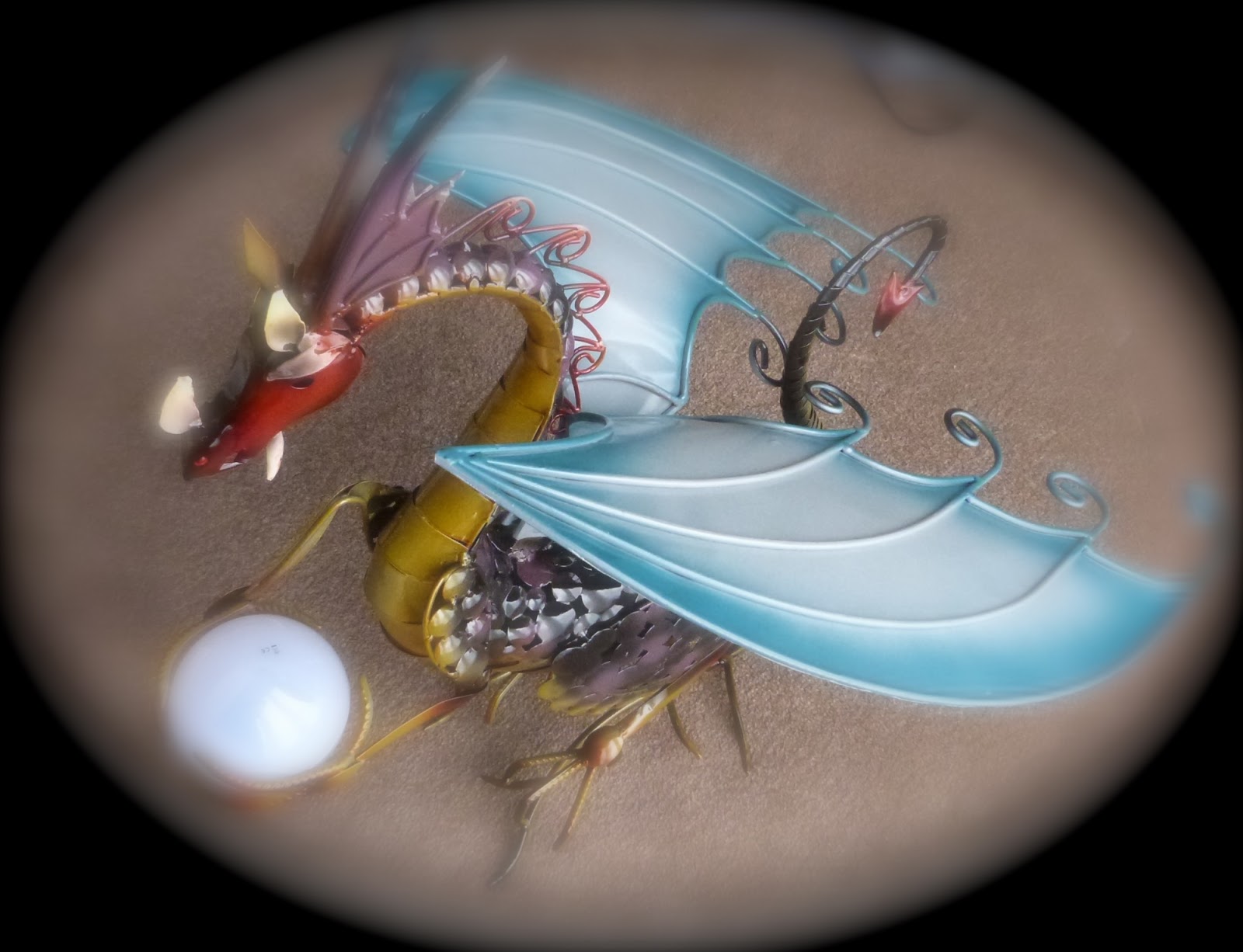
I make no secret about the fact I love dragons and own a few. Some would say more than few but they fill only one cabinet so it's far less than I could own if I let myself buy every one that caught my eye. Buying dragons began a while back. If I saw one that 'spoke to me', as such objects do, while on holiday in the UK I would bring take it home with me. In that respect my dragon collection has taken many years and hasn't grown all that fast. I bought another the other day, people cried out to see it, and so I decided to share the occasional post featuring my dragons.
There isn't much of a story to go with this one except it's a garden ornament I have no intention of putting in the garden. It's metal and no matter how many years it's designed to last, invariably the elements will wear it down. I'll set him by a window in the hope the light will work but, if it doesn't, I didn't buy it for the light. I loved the colours. When my other half first saw this his words were, "Is that a garden ornament?" to which I replied yes. "I wouldn't put that in the garden," he said so there is some method to my madness.
The other week I read a post by Isaac Marion. He’s the author of the best-selling WARM BODIES, made into a film. He’s a success. A writer who has ‘made it’ in the world of the book industry, right? With a film (somewhat based) on one of his books, how could he not? Alas, being a writer is rarely that simple.
As I had already discovered, Warm Bodies is now the first in a trilogy. I read the second title, THE BURNING WORLD, this year after discovering its existence. I include my thoughts on both books below but what I didn’t know until more recently is that the third title, THE LIVING, is burning a hole in Isaac Marion’s hard drive, the author having finished it almost a year ago.
Although the first book was on the NYT bestseller list, book 2 hasn’t done so well, and, unless it does, there may be a no go on the third title. If it comes to that, I can only hope the author will find another publisher or go the route so many writers have to and self-publish (if contracts allow, mind). I won’t go into the pros and cons of that in this blog but I’m using it to illustrate one of the many reasons ‘why’ authors turn to self-publishing and why the perception that indie is purely amateur hour is false.
Not everything is as elementary as writers or readers would like to believe. This is a perfect example of the struggle writers face, of how ‘every’ book is as good as starting from scratch. Akin to an actor reading for a role, writers audition every time they submit a manuscript, and, if expectations aren’t met, the writer may have to climb a proverbial ladder again even if they’ve notched up a bestseller on any of the rungs close to the top.
That’s the truth, a simple, not-so-pretty fact about publishing. Unless the writer is a huge, well-known, consistently best-selling name (brand) often seen in the top 10, their next title will not automatically get snapped up. Even if under contract ‘to be published’ it may get pushed back or off a publisher’s list and, depending on the contract clauses, end up in limbo with the writer in purgatory. And I've known more than one writer to be in this position.
One thing I have to add is that I hadn’t heard a thing about the release of the second book or that even one existed. This leads into one of the biggest battles writers deal with every day — the need for marketing, something too often left to writers in the present climate. Most publishers do not have huge marketing budgets; many have none. Writers have even less but the expectation falls on them to get the word out. I only came across the second title because the question, ‘I wonder whether Isaac has written anything else’ popped into my head.
As to those books: I first read Warm Bodies about 4 years ago. With my hands on the novella prequel and the novel sequel I dipped in again. First, a word on the film of the book. It's not bad, but it uses the more humourous parts to convey the author's much more visceral idea in a too-light way. When I first saw trailers I imagined the book to be a Young Adult 'popcorn' story, a jokey hoot. Do yourself a favour; if you've seen the film, regardless of whether you liked it, DO read the book. It's a decidedly different experience.
With the characters of 'R' and Julie, the setting is a modern twist on Romeo and Juliet set in a dystopian future where zombies outnumber the living. Even many of the survivors seem dead inside, imprisoned as they are behind their safety barriers. Like many zombie books this is a story that questions and reflects society, but in a skillful way. An unexpected read the first time around, and no less pleasurable the second. The book contains threads of something dark and disturbing, yet enlightening, will speak to some people though not all; I hope it speaks to many. This is not a gory horror novel, not a teen rom-com spoof. Hidden within its pages the tale celebrates life in all its messiness. The story is a metaphor for so many things, the state of the world, the meaning of life, civilisation out of control. It imparts the essence of almost every zombie story and life itself. It's a book about living.
Where Warm Bodies stopped, the Burning World continues, and the story seems to speak on a wider basis reflecting society, the way we view authority and vice versa, the way countries are run. Maybe because Warm Bodies felt like a complete read I didn't enjoy this as much, which isn't to say I disliked it. It's definitely a worthwhile read, earns maybe one star less than the full score of the first title. I'll be interested to see where the author is going with this series. Warm Bodies is a book about living. The Burning World reflects more on ‘how we live’, on the quirks of society and how it's governed.
If you read Warm Bodies and are interested in following further chapters in R’s world then it’ll be worthwhile to help Isaac out by buying The Burning World (and no, I do not personally know the author before anyone asks, but I loved the first book, enjoyed the second, and long for the third).
It’s just as well only my husband is present during our recent binge ‘catch-up’ watch of The Walking Dead. Like a participant in Gogglebox — a show that invites the audience to watch people watching television (though I’ve only seen adverts for it, some reactions can be to great comic effect) — I’m not a silent viewer.
This is a trait that once drove my relatives to gritting their teeth with irritation, much as I do when an inconsiderate cinema-goer persists on talking during a film, or won’t put their phone away. I appreciate the frustration; however, in the cinema I restrict myself to a few gasps or loud laughter when appropriate. It’s an entirely different experience with an unspoken rule of no talking. I’ve paid a ticket and want to be submersed. I have never, unlike when a grandmother of mine went to the cinema, made not only a public faux pas, but done so twice in the time it took to run through a single showing.
The film was The Time Machine, the classic version starring Rod Taylor made in 1960. She went with her husband and her adult children, and they arrived just as the film started. Although only the opening credits were rolling, my nan, intent on not missing a minute, gaze glued to the screen, fumbled her way along a line of people already seated. I heard the story of how she stopped one seat short of her own chair and plopped herself down on a bald man’s lap. I’m unsure as to the significance of his being bald other than that being the way she forever thereafter described him amidst general hilarity, but I am confident he was as surprised as she. My nan made everyone switch seats so she could sit as far away from him as possible and then sat hidden and, she hoped, forgotten in the darkness...
Until the moment when ‘George’ makes his way into the Morlock cave and we see their gleaming eyes. While the hero tries to creep around and the Morlocks brace to launch an attack, my grandmother gasped, put her hands to her face and shouted out, “Watch out, he’s behind you!” The cinema audience on this occasion met my nan's outburst with a round of laughter adding to the collective enjoyment.
I once worked with a woman who never understood this. When I referred to laughing or crying over stories — viewed or read — she always shook her head. Strange from someone who read all the time and professed to be a bookworm.
“But...but...but…” I stuttered, “how can you not cry over a sad scene?”
“But it’s not real,” she said.
As one who understands that stories are our way of examining and learning how to deal with reality, I beg to differ. As someone who has had to put a book down in a crowded train carriage owing to the risk of a tear or two escaping among strangers with no easy-to-explain reason, I fail to understand this lack of emotional attachment. Thrill seekers get on roller coasters looking for that up and down ride of a lifetime; book lovers take more tight turns and steep slopes lasting far longer than your average amusement park ride. Our pulses speed up, our stomachs grow tight, our throats close, we cry, and scream, and shout...with anger, with pain, with frustration, and with joy. Even when it hurts, we consider ourselves lucky.
Watching a beloved character's harrowing death the other night (even though through reading the graphic novel I had a sense of what was coming), make no mistake, I was vocal about it. Feel free to share whether you experience a story without emotion or find it next to impossible not to laugh when something is funny, cheer when the outcome is good, or scream when it’s the end you were dreading.


 Please welcome Clarissa Johal. I'm currently reading her book, 'Between'.